
Why Self-Belief Drives Achievement: Your 2026 Guide
Self-belief is defined as your conviction that you can succeed at a specific task. It is the single strongest predictor of achievement across education, sports, and health, outperforming talent, IQ, and prior experience as a performance variable. Psychologists call this construct self-efficacy, a term introduced by Albert Bandura to distinguish task-specific belief from general optimism or self-esteem. Understanding why self-belief drives achievement is not abstract philosophy. It is a practical question with a clear, research-backed answer: belief shapes the choices you make, the effort you invest, and how you respond when things get hard.
Why self-belief drives achievement in goal pursuit
Self-belief determines which goals you attempt and how hard you fight for them. Bandura’s research shows that people with high self-efficacy select more ambitious tasks, invest more effort, persist longer, and interpret obstacles as solvable problems rather than proof of incompetence. That causal chain is the core mechanism behind self-confidence and success.
The role of mindset in success becomes visible when you compare two people facing the same obstacle. The person with strong self-belief treats difficulty as a challenge that requires more effort. The person with weak self-belief treats the same difficulty as a threat that confirms their inadequacy. Same obstacle. Completely different behavioral outcomes.

Persistence is where self-belief pays its biggest dividend. Most meaningful goals require sustained effort over months or years. People who believe they can improve keep showing up after setbacks. People who doubt themselves withdraw early, which guarantees failure and reinforces the original doubt. Self-belief breaks that cycle.
Emotional reactions to difficulty also shift when belief is strong. High self-efficacy reduces anxiety and increases focus during hard tasks. That calmer emotional state improves decision quality and learning speed, compounding the advantage over time.
- High self-efficacy people choose harder goals and stick with them longer.
- They interpret setbacks as information, not identity.
- They maintain focus under pressure because they expect to eventually succeed.
- They invest more effort, which produces better results, which strengthens belief further.
Pro Tip: Reframe every failure as evidence collection. Each attempt, successful or not, gives your brain real data to calibrate a more accurate and durable belief in your abilities.
What does neuroscience say about self-belief?
The brain processes self-belief through specific circuits, not vague feelings. The ventromedial prefrontal cortex evaluates self-relevant information and assigns confidence estimates to future actions. The ventral striatum and dopamine reward circuitry encode what researchers call prediction errors, the gap between what you expected and what actually happened.
When you attempt something and succeed, dopamine signals update your confidence estimate upward. When you fail, the signal revises it downward. Studies confirm that the brain updates confidence based on actual actions and feedback, not on intentions or encouragement alone. This is why telling yourself “I believe in you” without taking action produces almost no lasting change in self-belief.
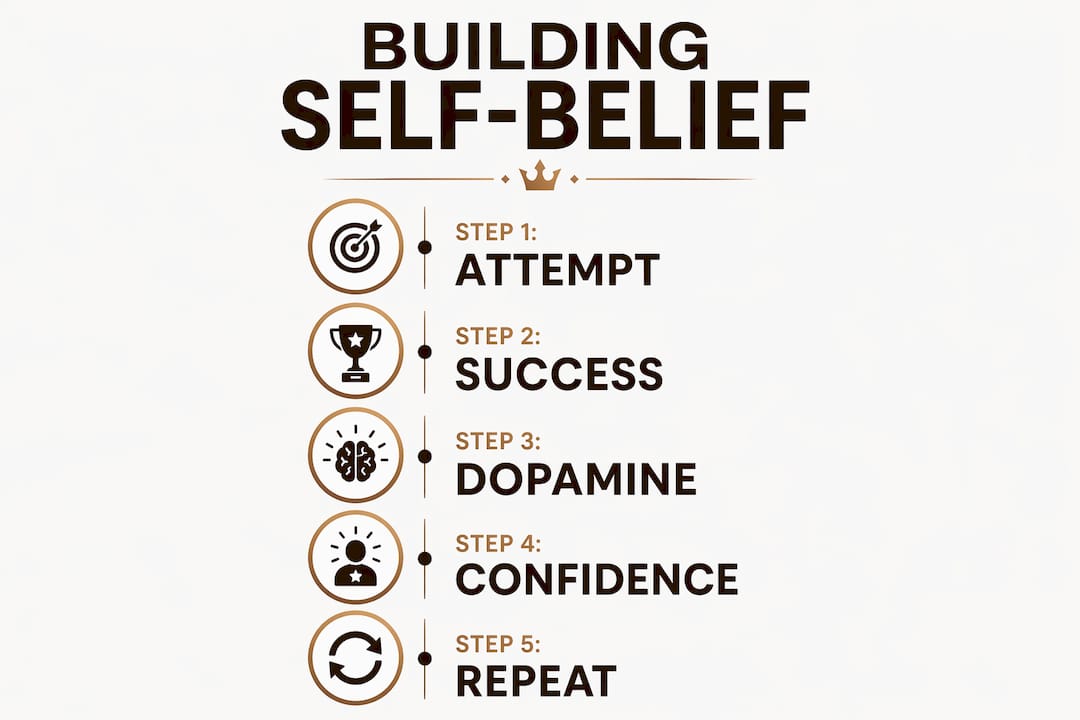
The practical implication is significant. Confidence is not a feeling you wait for. It is a neurological output that follows behavior. Acting despite discomfort generates the performance feedback that rewires your brain’s confidence estimates. Waiting for confidence before acting does the opposite. It strengthens avoidance patterns and keeps belief low.
| Brain Region | Function | Impact on Self-Belief |
|---|---|---|
| Ventromedial prefrontal cortex | Evaluates self-relevant information | Sets confidence estimates for future tasks |
| Ventral striatum | Processes reward and motivation | Drives effort toward goals |
| Dopamine circuitry | Encodes prediction errors | Updates belief after success or failure |
Pro Tip: Use graded exposure to build belief systematically. Start with tasks slightly outside your comfort zone, succeed repeatedly, then increase difficulty. Each small win sends a positive prediction error to your brain and raises your confidence baseline.
What are the biggest barriers to self-belief?
The brain is wired with a negativity bias. Research shows that one failure can undermine multiple prior successes because the brain weights negative outcomes more heavily than positive ones. This is not a character flaw. It is a neurological default that requires deliberate counteraction.
Low self-esteem compounds the problem. A 2026 study found that people with lower self-esteem attribute failure internally and discount their successes, creating a feedback loop that keeps self-efficacy suppressed. They hear criticism and absorb it as truth. They receive praise and dismiss it as luck. That attribution pattern is one of the most damaging barriers to personal growth.
A second barrier is confusing general confidence with domain-specific self-efficacy. Self-efficacy is task-specific and varies widely across different skills in the same person. Someone can have high self-efficacy in public speaking and low self-efficacy in financial planning. Treating confidence as a single global trait leads to vague affirmations that produce no measurable change.
Strategies that actually work against these barriers:
- Mastery experiences. Succeed at progressively harder versions of the target skill. This is the most potent source of self-efficacy.
- Credible encouragement. Seek feedback from people who know the domain and have seen you perform. Generic praise does not move the needle.
- Physiological state regulation. Interpret physical arousal (racing heart, adrenaline) as readiness rather than fear. That reframe reduces anxiety and improves performance.
- Realistic goal framing. Set goals that stretch your current ability without being so distant they feel impossible. Realistic, measurable goals combined with adaptive adjustment sustain belief over time.
How to build self-belief for real achievement
Building self-belief follows a specific sequence. Skipping steps produces temporary motivation, not lasting change.
-
Identify the specific domain. Self-efficacy is not general. Pinpoint the exact skill or task where you want to grow. “Be more confident” is not a target. “Deliver a five-minute presentation without notes” is.
-
Start smaller than feels necessary. The goal is to collect wins, not to impress anyone. Mastery experiences are the most effective way to build long-term self-belief. A win at 60% difficulty still sends a positive signal to your brain.
-
Use vicarious learning. Watch people at a similar starting point succeed at the task you want to master. The brain uses social comparison to calibrate what is possible for someone like you. Watching elite performers can actually lower self-efficacy if the gap feels too large.
-
Manage your physical state before performance. Breathing exercises, physical warm-ups, and pre-performance routines reduce cortisol and shift your interpretation of arousal from threat to readiness. That physiological shift directly improves confidence and output quality.
-
Act despite discomfort. Confidence grows as a byproduct of action and exposure to challenges, not as a prerequisite to starting. Waiting until you feel ready is the most reliable way to never feel ready.
-
Adjust goals adaptively. When a goal proves too far beyond current ability, revise it downward without shame. Adaptive adjustment maintains momentum and keeps belief intact. Rigid goal attachment in the face of repeated failure destroys both.
Pro Tip: Collect written evidence of your progress. After each attempt, note one thing that went better than expected. Over weeks, this record becomes a concrete argument against your own negativity bias.
Key Takeaways
Self-belief, defined as domain-specific self-efficacy, is the strongest psychological predictor of achievement because it shapes effort, persistence, and how people respond to failure.
| Point | Details |
|---|---|
| Self-efficacy predicts performance | Belief in task-specific ability outperforms talent and IQ as a predictor of success. |
| Action builds confidence | The brain updates belief through performance feedback, not intentions or affirmations. |
| Negativity bias is the core barrier | One failure can erase multiple successes neurologically; deliberate counteraction is required. |
| Mastery experiences are most effective | Repeated small wins in a specific domain build the most durable self-belief over time. |
| Domain specificity matters | Target belief-building at the exact skill you want to improve, not confidence in general. |
The paradox I keep coming back to
People spend years waiting to feel confident before they act. I have done it. Most people I know have done it. The research is unambiguous on what that waiting actually produces: more anxiety, stronger avoidance habits, and a belief system that stays exactly where it started.
The uncomfortable truth is that confidence is not a character trait some people are born with. It is a neurological output. Your brain builds it from evidence, and evidence only comes from doing things. Imperfect things. Uncomfortable things. Things you are not sure you can finish.
What I have found genuinely useful is separating self-belief from self-esteem. Self-esteem is how you feel about yourself globally. Self-efficacy is what you believe you can do in a specific situation. You can have shaky self-esteem and still build strong self-efficacy in one domain by showing up and collecting wins. That distinction freed me from waiting to “feel better about myself” before attempting hard things.
The other shift worth making is treating failure as calibration, not condemnation. Every failed attempt gives your brain more accurate data about what the task actually requires. That data is the raw material for a more realistic and durable belief. Failure is not the opposite of self-belief. It is one of its primary building blocks.
— Kofi
Wear the reminder every day
Mrhappinessofficial was built on one idea: you do not need a label to feel important. You already are. The brand creates premium streetwear designed to remind you of that fact every time you get dressed.
The Signature Collection includes the “Be Unforgettable” Hoodie, the “Mind Over Noise” Joggers, and the Statement Oversized T-Shirt. Each piece carries a message built for people who protect their mindset and live without apology. The “Be Unforgettable” Hoodie is a daily reminder that your identity is not up for debate. Wear the reminder. Own the standard.
FAQ
What is self-efficacy and how does it differ from self-esteem?
Self-efficacy is your belief in your ability to succeed at a specific task. Self-esteem is a global evaluation of your worth. They are related but distinct, and you can build strong self-efficacy in one domain even when overall self-esteem is low.
Why does self-belief matter more than talent?
Self-efficacy is the strongest predictor of performance across education, sports, and health, outperforming raw talent. Talent sets a ceiling, but self-belief determines how close to that ceiling you actually get.
How does failure affect self-belief?
The brain’s negativity bias means one failure can outweigh multiple successes in shaping belief. Reframing failure as evidence collection rather than proof of inadequacy is the most effective way to prevent it from permanently lowering self-efficacy.
Can you build self-belief without feeling confident first?
Yes. Confidence grows through action and performance feedback, not through waiting for the right feeling. Taking action despite discomfort is the mechanism that generates the neurological signals that build lasting belief.
What is the fastest way to increase self-belief in a specific skill?
Mastery experiences, meaning repeated successful performances at progressively harder versions of the target skill, are the most potent source of self-efficacy. Start smaller than feels necessary and build from there.