
Why Self-Awareness Builds Confidence That Actually Lasts
Self-awareness is defined as the conscious knowledge of your own character, emotions, strengths, and weaknesses. It is the foundation of genuine confidence because it replaces guesswork about who you are with clear, honest self-knowledge. Without it, confidence is fragile. It depends on other people’s approval, external results, and circumstances you cannot control. With it, confidence becomes internal, stable, and yours to keep. Understanding why self-awareness builds confidence is one of the most practical insights in personal development today.
Why self-awareness builds confidence: the research case
The connection between self-awareness and confidence is not abstract. A 2026 academic study found a significant positive correlation between self-awareness and self-esteem, with a correlation coefficient of r = 0.72. That number means the two qualities move together strongly. People who know themselves well tend to feel better about themselves.
Self-awareness and self-esteem are not the same thing, but they reinforce each other. When you accurately understand your strengths, you stop underselling yourself. When you honestly recognize your weaknesses, you stop being blind sided by them. Both outcomes reduce the internal noise that erodes confidence over time.

2026 research on adolescent development identifies self-awareness as a trainable skill that directly supports identity integration and emotional regulation in adults aged 18–30. Identity integration means you hold a consistent, coherent sense of who you are across different situations. That consistency is what makes confidence feel real rather than performed.
Pro Tip: Keep a weekly “strength log.” Write down three moments where you acted in line with your values. Over time, this log becomes evidence of who you actually are, not who you fear you might be.
| Benefit of self-awareness | How it builds confidence |
|---|---|
| Accurate self-assessment | Stops both underselling and overestimating your abilities |
| Emotional regulation | Reduces reactive behavior that undermines self-trust |
| Identity integration | Creates a stable sense of self across different situations |
| Strength recognition | Gives you concrete proof of your own capability |
Does self-awareness alone build confidence?
Self-awareness alone does not build confidence. This is the part most personal development content skips. Knowing your flaws in detail without the capacity to accept them creates a specific kind of suffering. Research on the amygdala’s response to self-criticism shows that self-awareness without self-esteem can increase anxiety and trigger a protective brain response that blocks growth.
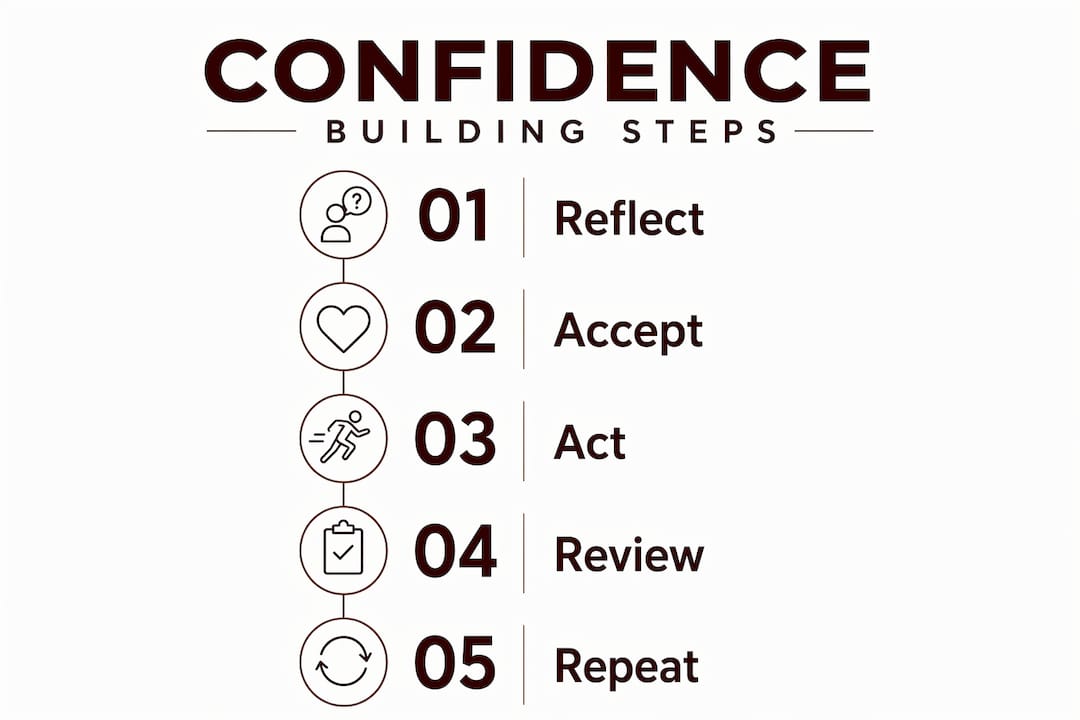
Think of self-awareness as data. Data is neutral. What you do with it determines whether it builds you up or tears you down. As one 2026 insight puts it directly: self-awareness is “just data.” Without confidence, that data fuels self-doubt rather than growth.
Self-compassion is the missing piece. It is not about excusing poor behavior. It is about processing what you see in yourself without turning every flaw into a verdict on your worth. Pairing self-awareness with self-compassion and deliberate action is what builds lasting self-esteem.
The practical difference shows up in how you handle mistakes. A person with self-awareness and self-compassion sees a mistake, names what went wrong, and adjusts. A person with self-awareness but no self-compassion sees the same mistake and spirals. The goal is the former.
- Name what you observe, not what you conclude. Say “I avoided that conversation” instead of “I am a coward.”
- Separate behavior from identity. What you did in one moment is not who you are permanently.
- Use the growth mindset frame. Treat every flaw as a skill gap, not a character defect.
- Practice forward-looking reflection. After identifying a weakness, ask what one small change would look like next time.
Pro Tip: After any setback, write two sentences: one describing what happened factually, and one describing what you will do differently. This keeps reflection from becoming rumination.
How to build confidence through self-reflection and daily practice
Building confidence through self-reflection requires two directions at once: looking inward and seeking honest feedback from outside yourself. Psychology Today’s 2026 analysis confirms that both inward reflection and external objective feedback are necessary to enhance confidence effectively. Neither alone is sufficient.
The inward side includes mindfulness practice and journaling. Mindfulness trains you to observe your thoughts without immediately reacting to them. Journaling creates a written record of your patterns, which is far more reliable than memory. Together, they build the habit of honest self-observation.
The outward side means asking people you trust for specific, behavioral feedback. Not “What do you think of me?” but “What do I do when I’m under pressure that works well, and what gets in the way?” Specific questions get specific answers. Specific answers are actually useful.
The mechanism that connects reflection to confidence is what behavioral science calls the micro-action principle. Small, value-aligned behavioral shifts build the neural pathways essential for genuine confidence. Repetition over seven or more days is recommended for these shifts to take hold. The brain learns confidence the same way it learns anything: through repeated experience.
- Identify one core value you hold. Examples include honesty, creativity, or reliability. This becomes your anchor.
- Choose one micro-action that reflects that value. Speak up in one meeting. Follow through on one small commitment. Write for ten minutes without stopping.
- Repeat the micro-action daily for at least seven days. Consistency is what rewires the pattern, not intensity.
- Notice the pattern interruption. Approximately two-thirds of daily behavior runs on autopilot. Self-monitoring breaks unhelpful automatic responses and replaces them with deliberate ones.
- Review your strength log weekly. Connect the micro-action back to evidence of who you are becoming.
Pro Tip: Pair your journaling with the “Mindset Over Opinion” Pants from Mrhappinessofficial as a physical reminder that your mindset belongs to you, not to outside opinion.
How does self-awareness reduce the need for external validation?
Self-awareness shifts the source of confidence from outside to inside. Individuals with authentic self-awareness build confidence that does not depend on external validation but on internal clarity and acceptance. That shift is significant because external validation is unreliable. Approval from others fluctuates. Your own honest self-knowledge does not.
The practical effect shows up in decision-making. Self-awareness facilitates faster, value-aligned decisions by reducing mental noise. When you know what you value and what you are genuinely capable of, you second-guess yourself less. Decisions become clearer because you have a reliable internal reference point.
This also changes how you relate to your limitations. A person who knows their limits does not experience them as shameful secrets. They experience them as information. That information helps them ask for support when they need it, delegate what they should not carry alone, and focus energy where they are actually strong.
- Clarity on values removes the need to perform for an audience. You act because it aligns with who you are, not because someone is watching.
- Honest strength recognition means you stop waiting for permission to trust yourself.
- Acknowledging limits reduces the anxiety of pretending to be capable of everything.
- Grounded self-knowledge creates the kind of confidence that holds steady when criticism arrives.
True confidence, as Mrhappinessofficial puts it, is not priced, labeled, or given by the world. It is who you are. Self-awareness is the process of finding out who that actually is.
Key Takeaways
Self-awareness builds confidence by replacing fragile, approval-dependent self-belief with honest, stable self-knowledge that supports clear decisions and consistent growth.
| Point | Details |
|---|---|
| Self-awareness correlates with confidence | A correlation of r = 0.72 shows that stronger self-knowledge consistently links to higher self-esteem. |
| Self-compassion is required | Self-awareness without self-compassion increases anxiety rather than building confidence. |
| Micro-actions rewire confidence | Small, value-aligned behaviors repeated over seven or more days build genuine neural pathways for confidence. |
| External validation becomes optional | Authentic self-awareness creates internal clarity that makes approval-seeking unnecessary. |
| Both reflection and feedback matter | Inward journaling and honest external feedback together produce the most accurate self-knowledge. |
What I’ve learned about self-awareness and real confidence
Most people treat self-awareness as a destination. They think that once they understand themselves well enough, confidence will follow automatically. That is not how it works. I have seen people spend years cataloging their flaws with impressive precision and still feel stuck. The problem is not lack of insight. The problem is the gap between knowing and doing.
The concept that changed how I think about this is what some researchers call “articulate paralysis.” You can describe your patterns, name your triggers, and explain your tendencies in detail. But if none of that knowledge connects to a changed behavior, it just becomes a more sophisticated story about why you cannot move forward. The action bridge is what matters.
What actually builds confidence is the smallest possible action taken in the direction of your values. Not a dramatic overhaul. Not a perfect plan. One honest conversation you kept avoiding. One commitment you followed through on when it was inconvenient. One moment where you chose your own judgment over someone else’s approval. Those moments stack. They become evidence. Evidence becomes belief.
Imperfections are not obstacles to confidence. They are the material you work with. The people I have seen carry real confidence are not the ones who have eliminated their weaknesses. They are the ones who know their weaknesses well enough to work around them, ask for help, and keep going anyway.
— Kofi
Wear the reminder every day
Confidence is not a feeling you wait for. It is a practice you build. Mrhappinessofficial creates premium streetwear designed to carry that reminder into your daily life.

The signature “Be Unforgettable” Hoodie and the Statement Oversized T-Shirt are built for people who are done chasing approval and ready to live from the inside out. Every piece in the Mrhappinessofficial collection carries the same message: special is not something the world assigns you. It is who you already are. Wear the reminder.
FAQ
What is self-awareness in personal development?
Self-awareness is the conscious understanding of your own emotions, strengths, weaknesses, and values. It is a trainable skill that directly supports identity integration and emotional regulation, both of which are foundational to building confidence.
Can self-awareness increase confidence over time?
Yes. Research shows a strong positive correlation between self-awareness and self-esteem (r = 0.72), meaning that as self-awareness grows through consistent practice, confidence tends to grow with it.
Why does self-awareness sometimes increase anxiety instead of confidence?
Self-awareness without self-compassion triggers a protective brain response, including heightened amygdala activity, that blocks growth. Pairing honest self-knowledge with self-acceptance is what converts awareness into confidence rather than self-doubt.
How long does it take to build confidence through self-reflection?
Behavioral science recommends repeating small, value-aligned micro-actions for at least seven consecutive days to begin building new neural pathways. Consistency over time matters more than the size of any single action.
What is the difference between self-awareness and self-esteem?
Self-awareness is knowing who you are. Self-esteem is how you feel about who you are. The two are closely linked but distinct. Strong self-awareness supports self-esteem by giving you accurate, honest information about your strengths and limits rather than distorted self-perception.