
Why Confidence Is a Daily Practice: Small Rituals That Work
Confidence is a skill you train every day. It is not a trait you’re born with. It is not a feeling you wait for. Mastery experiences — the small, repeated actions that produce real evidence of capability — are how the brain updates its belief in what you can do. Albert Bandura’s self-efficacy research, widely cited by the American Psychological Association, confirms this: action comes first, confidence follows. At Mrhappinessofficial, that principle is built into every piece — clothing as a daily reminder that who you are doesn’t need a price tag to prove it. Below, you’ll find a short, timed routine and the science behind why practicing self-assurance every morning changes everything.
Table of Contents
- Why confidence is a daily practice, not a personality trait
- Daily rituals that train your confidence muscle
- A simple 5–10 minute daily routine you can actually keep
- How do you measure progress and recover after setbacks?
- Common myths about confidence worth dropping now
- Key Takeaways
- How outfit cues support the confidence habit
- Wear the reminder every day
- Further reading and key sources
Why confidence is a daily practice, not a personality trait
The brain doesn’t hand out confidence in advance. It revises its estimate of your capability based on what you actually do. That’s the core of Bandura’s self-efficacy model: capability beliefs update from performance outcomes, not from private preparation or positive thinking.
Neuroplasticity makes this compounding. Every time you take a small, confident action, you reinforce a neural pathway. Repeat it enough and the behavior becomes automatic. The brain, quite literally, rewires around what you practice. Uncertainty tolerance works the same way: clinical research shows that acting in the presence of doubt, repeatedly, increases your willingness to keep acting. Doubt doesn’t disappear. Your relationship with it changes.
Confidence is also a lagging indicator. Waiting to feel ready before acting traps you in avoidance. The corrective is designing low-risk, repeatable actions that force movement and produce evidence. Small reps, done consistently, compound into durable self-trust.
Daily rituals that train your confidence muscle
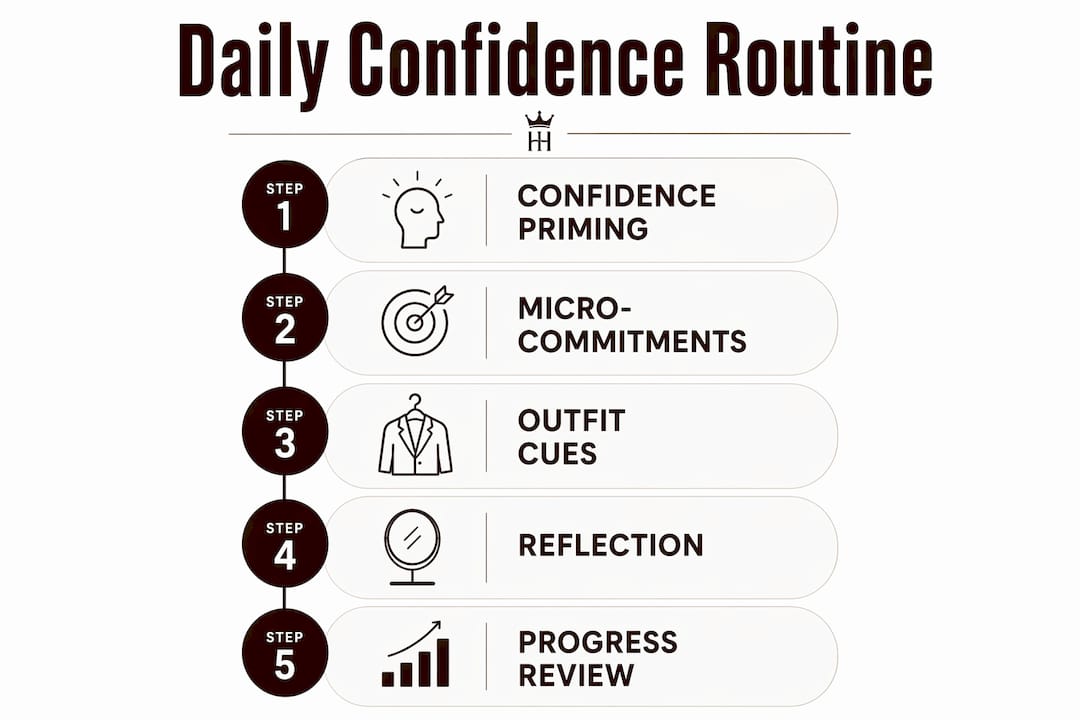
A few reliable micro-habits, stacked daily, compound faster than any single dramatic effort. Motivation is episodic; systems are what sustain progress. Here’s a practical menu:
- Confidence priming: Spend 60 seconds recalling one past win before a challenge. Grounds the nervous system in evidence, not hope.
- Micro-commitments: Make one small promise to yourself and keep it. “I’ll send that email.” “I’ll do ten push-ups.” The act of following through builds self-trust faster than any affirmation.
- Success log: Write down one thing you handled well today. Not a highlight reel. Just honest evidence.
- Body alignment: Roll shoulders back, lift your chin, take up space. Research consistently shows posture influences how you feel, not the other way around.
- Decision practice: Make one small decision without overthinking it. Confidence grows from choosing, not from certainty.
- Small social risks: Start one conversation. Ask one question in a meeting. The goal is proof that discomfort won’t end you.
- Micro-skill practice: Spend five minutes on one skill you want to own. Repetition builds the mastery experiences that update self-belief.
- Outfit as intent cue: Put on a piece that carries meaning. A signature hoodie or statement tee can function as a physical anchor for the mindset you’re building.
Pro Tip: Size micro-commitments so the expected success rate is high. Attempting tasks beyond your current bandwidth increases failure rates and erodes self-trust — a pattern practitioners call identity inflation. Keep the bar low enough to win, then raise it gradually.
| Ritual | Time Cost | Psychological Mechanism | Streetwear Cue Example |
|---|---|---|---|
| Confidence priming | 1 min | Mastery recall activates self-efficacy | Wear a piece tied to a past win |
| Micro-commitment | 2 min | Self-trust via follow-through | Put on your outfit before the task |
| Success log | 2 min | Evidence accumulation | Note what you wore when you showed up |
| Body alignment | 30 sec | Posture-to-mood feedback loop | Statement tee as a posture prompt |
| Small social risk | 5 min | Uncertainty tolerance via exposure | Wear something bold; let it lead |

A simple 5–10 minute daily routine you can actually keep
One rule: start dressed. The routine is built around getting dressed with intention, not after.
- 0:00–0:30 — Anchor the piece. Pick one item that carries a reminder. The Mrhappinessofficial Signature Zip Hoodie or a statement oversized tee works well here. As you put it on, say one sentence aloud: “I show up even when I’m not sure.” That’s the priming rep.
- 0:30–2:00 — Set one micro-commitment. One promise. Specific. Completable today. Write it on your phone or say it out loud. Not a goal list. One thing.
- 2:00–5:00 — Body alignment check. Stand tall. Shoulders back. Chin up. Thirty seconds in front of a mirror. You’re not performing confidence. You’re practicing the physical signals that tell your brain you belong.
- 5:00+ — Name your social risk. Before you leave, identify one small interaction you’ll lean into today. One sentence in a meeting. One question to a stranger. One direct reply instead of a deflection.
Tight morning? Compress to steps 1 and 2 only. Two minutes. Anchor piece, one commitment. That’s enough to start the loop.
Evening event? Run the priming step while dressing. Say the sentence. The outfit becomes the cue; the cue becomes the habit.
How do you measure progress and recover after setbacks?
Measure small. Track consistency, not perfection. Three metrics are enough:
- Micro-commitment keep rate: Did you do what you said? Track yes/no daily.
- Weekly wins logged: How many entries in your success log this week?
- Social risks attempted: How many small uncomfortable actions did you take?
Over 4–12 weeks, look for directional trends, not scores. Durable confidence typically develops over a 3–6 month horizon of consistent practice. Don’t expect a straight line.
| Week | Micro-Commitments Kept | Wins Logged | Social Risks Taken |
|---|---|---|---|
| 1 | 4/7 | 3 | 2 |
| 4 | 6/7 | 5 | 4 |
| — | 6/7 | 6 | 5 |
| 12 | 7/7 | 7 | 6 |
When confidence dips, run this rebuild sequence:
- Shrink commitments immediately. One tiny promise, nothing more.
- Complete two quick mastery reps. Something you already know you can do.
- Review your success log. Read three past entries.
- Reset daily goals to the smallest viable version.
Pro Tip: A confidence practice becomes easier to trust when you can point to a page and say, “I’ve done this 9 out of the last 12 days.” Use a habit tracker or a notes app. Visible evidence beats memory every time.
Common myths about confidence worth dropping now
Genuine confidence increases humility and curiosity. It doesn’t demand a room. Here’s what it’s not:
- Confidence = arrogance. Arrogance needs external validation. Real confidence is quiet self-assurance combined with respect for others. It shows up as admitting mistakes, not avoiding them.
- Confidence is innate. It’s task-specific and built through repetition. A surgeon becomes confident by operating. A speaker becomes confident by speaking. You become confident by doing the thing.
- Confidence needs constant validation. Practiced self-assurance doesn’t depend on approval. It’s loyalty to yourself, expressed in small daily acts.
- Confidence comes before action. It doesn’t. The sequence is: courage, then action, then experience, then confidence. Waiting reverses the order and reinforces avoidance.
Micro-behaviors that mark genuine confidence: accepting a compliment without deflecting, saying “I don’t know” without shame, and refusing to punish yourself publicly for mistakes. These aren’t soft skills. They’re daily acts of self-loyalty.
Key Takeaways
Confidence is built through daily action, not discovered through reflection. Small reps, done consistently, compound into durable self-trust over a 3–6 month horizon.
| Point | Details |
|---|---|
| Confidence is a skill | The brain updates capability beliefs from action, not from waiting to feel ready. |
| Daily reps compound | Micro-commitments, success logs, and small social risks build self-trust faster than occasional big efforts. |
| Track consistency, not perfection | Monitor micro-commitment keep rate, weekly wins, and social risks attempted over 4–12 weeks. |
| Setbacks have a reset script | Shrink commitments, run two mastery reps, review your success log, and reset daily goals. |
| Mrhappinessofficial as a daily cue | A signature piece worn with intention functions as a physical anchor for the confidence habit. |
How outfit cues support the confidence habit
Clothing is a cue. Not a costume. When you reach for a piece that carries a message, you’re not performing confidence. You’re rehearsing it. That rehearsal, repeated daily, is how identity shifts.
At Mrhappinessofficial, the design philosophy starts from this premise. Every hoodie, tee, and jogger is built to remind the person wearing it that special isn’t assigned by a label or a price. It’s already there. The apparel is the prompt. The practice is yours.
Premium craftsmanship matters here because a piece that holds its weight, its structure, and its message over time reinforces the habit. A garment that falls apart in three washes doesn’t function as a ritual anchor. Quality is part of the cue. Styling choices that align with your identity signal to your nervous system, before you’ve said a word, that you belong in the room.
The Mrhappinessofficial collection is built for people who are done wearing labels just to feel important. Wear the reminder. The confidence follows.
Wear the reminder every day
Mrhappinessofficial gives you the physical anchor your confidence routine needs. Not a motivational poster. A heavyweight, premium piece you put on every morning as the first rep of the day.

The Signature Zip Hoodie is built for exactly this: a structured, daily-wear piece that carries the reminder without shouting it. Pair it with the Reminder Oversized Tee for a text-based cue on lighter days, or the “Be Unforgettable” Hoodie when the intention needs to be louder. Try one piece for 14 days as your morning anchor. See what changes. Browse the full MR. HAPPINESS collection and pick the piece that fits the reminder you need most.
Further reading and key sources
- Psychology Today — The No. 1 Habit All Confident People Have: Anchors the mastery-experience and self-efficacy claims in the opening and explanation sections.
- American Psychological Association: Primary source for Bandura’s self-efficacy framework, uncertainty tolerance research, and neuroplasticity context.
- The Art of Charm — 12 Proven Daily Habits: Source for the 3–6 month confidence development horizon and daily habit recommendations.
- HelpGuide — How to Build Confidence: Reviewed mental health resource covering self-belief strategies and daily confidence frameworks.
- YourStory — 7 Daily Habits That Quietly Build Lasting Confidence: Supports the micro-commitment and small-wins framework.
- ConnorFields — The Psychology of Confidence: Source for the motivation-vs-discipline distinction and daily systems emphasis.
- Francesco Pecoraro — Building Confidence Through Small Daily Actions: Source for the identity inflation concept and micro-commitment sizing guidance.
- Christine Walter Coaching — How to Build Self-Confidence: Source for self-confidence as self-loyalty and the micro-behaviors list.