
What Does Owning Your Identity Mean for You?
Owning your identity is defined as the intentional practice of understanding your core values, beliefs, and personal history to govern your actions rather than defaulting to survival roles or social pressure. This concept, formally known in psychology as personal identity governance, goes far beyond self-awareness. It means you decide who you are. You stop letting circumstances, other people’s opinions, or inherited labels make that decision for you. Individuals who engage in genuine identity exploration navigate life transitions more effectively than those who accept predetermined societal definitions. That is not a small advantage. That is the difference between living your life and performing someone else’s version of it.
What does owning your identity mean for your mental health?
Identity ownership produces measurable psychological benefits. The connection between a clear sense of self and emotional well-being is direct. Narrative coherence, which is the ability to maintain a meaningful, integrated personal story, is a primary predictor of psychological well-being and resilience. When your story makes sense to you, you handle disruption better.
The benefits of understanding identity ownership show up in three specific areas:
- Resilience. People with high identity exploration and commitment demonstrate greater psychological well-being and authentic self-expression. Knowing who you are gives you a stable foundation when life gets unstable.
- Confidence. Clarity about your values removes the need for constant external validation. You stop seeking approval because you already know your own standard.
- Reduced anxiety. Setting boundaries that protect your energy is central to identity ownership. Boundaries reduce the mental load of managing other people’s expectations.
Identity also functions as personal infrastructure. Without defining it, your life runs on defaults set by others. Think of it like a house with no walls. Everything gets in. Nothing stays where you put it.
Pro Tip: Write down three non-negotiable values every morning. Not goals. Values. This daily practice builds the narrative coherence that psychologists link directly to resilience and well-being.

What are the common misconceptions about owning your identity?
Most people misunderstand what identity ownership actually requires. These misunderstandings keep people stuck, performing roles they never chose.
-
“My identity is fixed.” This is the most damaging misconception. Identity is a living process, not a fixed destination. Finalizing your identity too quickly leads to fragility. People who treat identity as permanent struggle most when life changes, because they have no framework for revision.
-
“Owning my identity means never changing.” The opposite is true. Sustained exploration and revision builds resilience. The goal is not a locked-in self-concept. The goal is a self-concept you actively maintain and update.
-
“Blaming others is easier than owning my story.” Self-ownership is a continuous process of refusing to outsource personal responsibility to external systems, social movements, or other people. Blame feels like relief. It is actually a trap that keeps you from governing your own life.
-
“I need certainty before I can commit to who I am.” The capacity to sit with identity uncertainty rather than rushing to closure actually predicts overall health and identity achievement. Discomfort with ambiguity is not a sign you are lost. It is a sign you are growing.
Sociocultural pressure compounds all of these. Families, communities, and social media all push ready-made identities. Accepting one without examination is not identity. It is costume.
Pro Tip: When you catch yourself blaming a circumstance for a pattern in your life, ask: “What choice do I have here that I haven’t made yet?” That question shifts you from passenger to driver.
How can you actively cultivate and protect your identity?
Identity ownership is not passive. It requires deliberate practice. The good news is that the practices are simple, even when they are not easy.
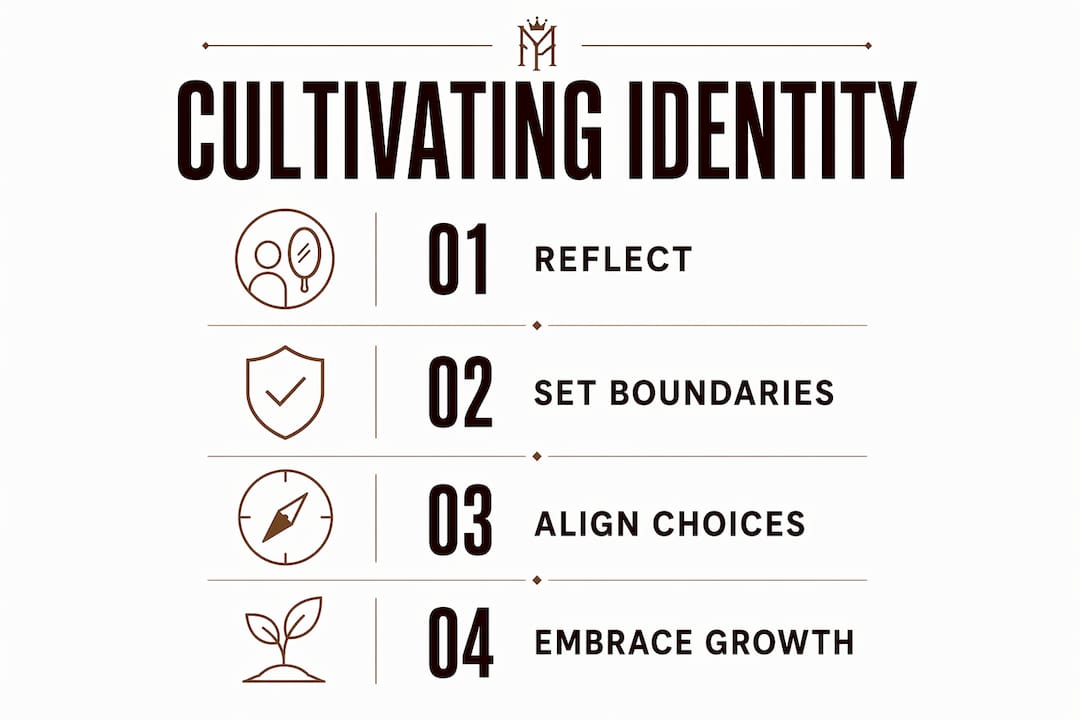
Build a self-reflection habit
Self-reflection is the foundation of personal identity governance. Journaling, meditation, or even a ten-minute walk without your phone creates space for honest self-assessment. The goal is to identify the gap between who you are acting like and who you actually want to be. Taking personal ownership means choosing your responses rather than letting circumstances dictate your actions.
Set boundaries that protect your time and energy
Boundaries are not walls. They are the rules of your house. Undefined identity lets others’ opinions dictate your decisions and relationships. A boundary says: this is where I end and where you begin. Setting one feels uncomfortable at first. That discomfort is social conditioning, not a moral signal.
Make choices aligned with your core values
Every decision is a vote for the person you are becoming. Small choices compound. The person who consistently chooses honesty over convenience becomes honest. The person who consistently chooses comfort over growth becomes comfortable but not fulfilled.
Here is a practical framework for identity-aligned decision-making:
| Decision area | Identity-aligned question |
|---|---|
| Relationships | Does this person respect who I actually am? |
| Career | Does this work reflect what I value, not just what pays? |
| Daily habits | Does this habit serve the person I want to be? |
| Social commitments | Am I saying yes because I want to, or because I fear saying no? |
Embrace identity as an ongoing process
Viewing identity as a fixed endpoint leads to anxiety. Welcoming ambiguity promotes resilience and authentic growth over time. You are not a finished product. You are a practice.
What role does identity ownership play in your relationships?
A well-governed personal identity changes how you show up with other people. The effects are specific and practical.
- Clearer communication. When you know what you value, you can say what you mean. Vague identity produces vague communication. People who own their identity tend to speak directly and listen without defensiveness.
- Resistance to manipulation. Clarity about who you are reduces vulnerability to confusion and coercion. Manipulators rely on ambiguity. A person with a clear self-concept is a harder target.
- Stronger trust. Consistency builds trust. When your actions match your stated values over time, people know what to expect from you. That predictability is not boring. It is the foundation of every meaningful relationship.
- Authentic connection. People connect with people, not performances. When you stop performing a role and start showing up as yourself, the relationships that form are built on something real.
Identity ownership also matters in professional settings. A person who knows their values negotiates better, sets clearer expectations, and recovers faster from workplace conflict. The importance of identity in professional life is often underestimated. Most career dissatisfaction traces back to a mismatch between personal values and the role being performed.
Key Takeaways
Owning your identity is a continuous, deliberate practice of self-governance that builds resilience, protects relationships, and produces lasting confidence.
| Point | Details |
|---|---|
| Identity ownership is intentional | It means governing your actions from your values, not from social pressure or survival instinct. |
| Narrative coherence predicts well-being | Maintaining a meaningful personal story is directly linked to psychological resilience and health. |
| Identity is a living process | Treating it as fixed leads to fragility; sustained exploration builds authentic strength. |
| Boundaries protect your identity | Undefined identity lets others set the rules of your life by default. |
| Ownership improves relationships | Clarity about who you are produces clearer communication, stronger trust, and resistance to manipulation. |
Why I think most people never actually own their identity
I spent years thinking identity was something you figured out once and then had. Like a degree you hang on the wall. What I actually found is that identity ownership is closer to physical fitness. You do not get fit and then stop. You maintain it, or you lose it.
The hardest part is not the self-reflection. It is the repair. Every time I acted against my own values, the temptation was to explain it away. Blame the situation. Blame the other person. Identity ownership involves walking away from blame as a habit. That is not comfortable. It is also the only path that actually works.
What surprised me most is how much lighter life gets when you stop outsourcing your self-concept. You stop needing the right clothes to feel important. You stop needing the right people to validate your worth. The Happiness Set from Mrhappinessofficial sits on my shelf not as a status symbol but as a daily reminder. Special is not priced. It is who you are. That shift in thinking is the whole game.
Humility matters here too. Owning your identity does not mean you have it all figured out. It means you are willing to keep figuring it out, honestly, without blaming the world for where you are.
— Kofi
Wear what you stand for
Mrhappinessofficial builds apparel around one idea: your worth is not assigned by a label, a price tag, or anyone else’s opinion. It is yours.
The “Be Unforgettable” Hoodie is built for people who have stopped chasing approval and started living from the inside out. Heavyweight. Clean. A reminder you wear every day. The “Mind Over Noise” Joggers carry the same intention. Comfort that does not compromise on what it stands for. Every piece in the full collection is designed for people who know who they are and want their wardrobe to reflect that. No performance. No costume. Just you.
FAQ
What does owning your identity mean in simple terms?
Owning your identity means intentionally understanding your core values and governing your choices from them, rather than letting external pressure or other people define who you are.
Is personal identity fixed or does it change over time?
Personal identity is a living process, not a fixed state. Sustained exploration and revision builds resilience, while treating identity as permanent leads to fragility when life changes.
How does identity ownership improve mental health?
Narrative coherence, the ability to maintain a meaningful personal story, is a primary predictor of psychological well-being and resilience. Identity ownership builds that coherence directly.
Why is how to embrace your identity so difficult for most people?
Social and cultural pressure constantly offers ready-made identities. Accepting them without examination is easier in the short term. Resisting that pressure requires deliberate self-reflection and a willingness to sit with uncertainty.
How does identity and self-acceptance connect to relationships?
A clear sense of self produces clearer communication, stronger boundaries, and resistance to manipulation. People who own their identity build relationships based on authentic connection rather than performance.