
The Role of Identity in Personal Success
Identity is defined as the internal self-concept that tells you who you are, and it is the single most powerful driver of lasting personal success. Not goals. Not skills. Not discipline. A 2026 study published in the Journal of Higher Education Policy and Management found that identity transformation explained over 50% of variance in job performance. That number climbs above 67% when identity is combined with skills usage. The role of identity in personal success is not motivational theory. It is measurable, documented, and more predictive than any goal-setting framework. Mrhappinessofficial was built on this exact truth: special is not given by the world. It is who you are.
How does identity drive motivation differently from goals?
Identity-based motivation theory, developed by researchers Oyserman and Destin, explains why identity outlasts goals as a behavioral driver. Goals require ongoing effort to maintain. Identity does not. Identity provides coherence to behavior by changing how you interpret difficulty. When you identify as a runner, a hard training session feels like proof of who you are. When you only have a goal to run, the same session feels like punishment.
The psychological mechanism behind this is cognitive dissonance. When your actions conflict with your self-concept, your brain creates discomfort until alignment is restored. That discomfort is not weakness. It is your identity pulling you back toward consistency. The commitment-consistency principle reinforces this: people act in line with who they believe themselves to be, not just what they want.
Behavior-focused goals tend to fail within 6 weeks, while identity-based habits produce durable, long-term change by bypassing willpower entirely. That is not a small distinction. It means the person who says “I am someone who does not skip workouts” will outlast the person who says “I want to get fit” every single time.
- Identity reframes setbacks as temporary, not defining
- Goals create pressure; identity creates direction
- Small identity-consistent actions accumulate as evidence of who you are
- Identity absorbs failure without collapsing motivation
Pro Tip: Reframe every goal as an identity transition. Instead of “I want to write a book,” say “I am a writer.” Then ask what a writer does today. That single shift changes how you respond to resistance.
Why does identity shape habits at a neurological level?
Identity acts as an internal operating system. Attempts to change behavior without updating identity cause internal conflict, and that conflict produces self-sabotage. The brain defaults to identity-consistent patterns because they require less cognitive load. Individuals acting in line with identity experience less willpower drain and greater behavioral consistency. That is why identity-based change feels effortless once it takes hold.
A meta-analysis of 13,340 participants across health behaviors found that habit and identity correlate strongly at r=0.55. Identity-relevant habits persist longer and become automatic. That correlation is not coincidental. It reflects the neurological reality that the brain encodes identity-consistent behaviors as defaults, reducing the friction required to repeat them.
“The most effective way to change your habits is to focus not on what you want to achieve, but on who you wish to become. Every action you take is a vote for the type of person you wish to be.”
Michael Phelps is a clear example. His coaches did not just train his body. They trained his identity as the greatest swimmer alive. He rehearsed his races mentally thousands of times before entering the water. That mental rehearsal was identity integration. He was not preparing to swim. He was reinforcing who he already believed himself to be.
Self-efficacy is the strongest predictor of behavioral performance, growing through mastery experiences that reinforce identity. Each small win does not just build skill. It builds the belief that you are the kind of person who wins. That belief is the engine.

What is identity lag, and why does it block success?
Identity lag is defined as the gap between your external achievements and your internal self-concept. You get the promotion, but you still feel like the junior employee. You build the business, but you still feel like a fraud. Identity lag describes when self-concept lags behind external success, causing self-sabotage despite full capability. This is why the most dangerous moment in a career is often not failure. It is success.
Identity lag is harder to address than a skill gap because it is invisible. You can measure a skill gap and close it with practice. Identity lag lives in the stories you tell yourself, and those stories run quietly in the background.
The symptoms are recognizable:
- Feeling like an imposter despite clear evidence of competence
- Reverting to old habits after achieving new milestones
- Downplaying achievements to feel comfortable in old social circles
- Avoiding opportunities that match your new level
Identity is a narrative shaped by repeated storytelling about oneself. Constructing positive, redemptive narratives improves wellbeing and motivation. That means closing the identity lag gap requires deliberate narrative work, not just more achievement.
Pro Tip: Write a one-paragraph story about who you are becoming, not who you were. Read it every morning for 30 days. Journaling your new identity into language is how the brain begins to accept it as real.
The goal is not to fake confidence. The goal is to give your self-concept time to catch up with the evidence your actions are already producing.
How can you use identity to build lasting personal success?
Personal identity growth requires a specific sequence. You do not wait to feel like a new person before acting like one. Identity changes through accumulating evidence via actions, not by waiting for identity to shift before acting. Start with the smallest identity-consistent behavior you can repeat daily.
Growth mindset framing, developed by Carol Dweck, treats identity as a direction rather than a fixed state. You are not a confident person or an insecure person. You are a person moving toward confidence through repeated choices. That framing removes the pressure of instant transformation and replaces it with sustainable momentum.
Mental contrasting, a technique developed by Gabriele Oettingen, pairs a clear vision of your future self with an honest look at current obstacles. Combined with implementation intentions (“When X happens, I will do Y”), this method bridges the gap between who you are and who you are becoming.
| Approach | Goal-based | Identity-based |
|---|---|---|
| Primary driver | External outcome | Internal self-concept |
| Response to failure | Motivation drops | Reframes as information |
| Willpower required | High | Low once identity is set |
| Durability | 6 weeks average | Long-term, automatic |
| Core question | “What do I want?” | “Who am I?” |
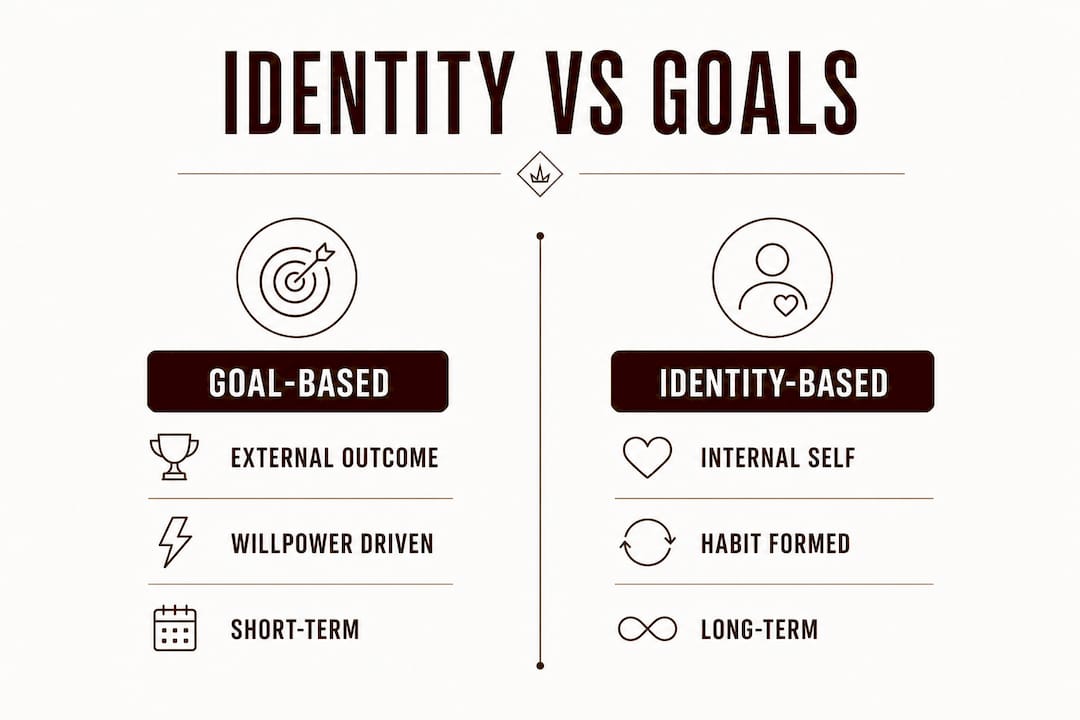
Building continuity with your future self through journaling and reflection is not optional. It is the mechanism. The architecture of identity is built by the stories you tell about yourself. Growth comes from consciously reshaping those narratives with intention and consistency.
Key Takeaways
Identity is the primary driver of personal success because it shapes behavior, absorbs failure, and creates durable motivation that goals alone cannot sustain.
| Point | Details |
|---|---|
| Identity outperforms goals | Identity-based habits outlast behavior-focused goals, which typically fail within 6 weeks. |
| Neurological alignment matters | Acting in line with identity reduces willpower drain and makes behavior automatic over time. |
| Identity lag is real | External success without internal self-concept updates causes self-sabotage and imposter feelings. |
| Actions build identity | Small, repeated identity-consistent behaviors accumulate as evidence of who you are becoming. |
| Narrative shapes self-concept | Journaling and storytelling are practical tools for closing the gap between old and new identity. |
Identity lag is the conversation nobody is having
I have spent years watching people hit real milestones and then quietly unravel. Not because they lacked skill. Not because the opportunity was wrong. Because their internal story had not caught up with the external reality. Identity lag is the most under-discussed obstacle in personal development, and it costs people more than any skill deficit ever could.
What I have found is that most people treat identity as a byproduct of success. They think, “Once I achieve X, I will feel like the person who deserves it.” That is backwards. The identity shift has to come first, or at least alongside the achievement. Otherwise, the brain treats the new level as foreign territory and pulls you back to familiar ground.
The uncomfortable truth is that personal identity growth is slow, deliberate work. It does not happen in a weekend workshop or after reading one book. It happens in the small moments where you choose the identity-consistent response over the comfortable one. Successful identity-driven change requires choosing responses consciously between stimulus and action. That is the real practice.
My advice is simple. Stop chasing the version of success that looks good from the outside. Start building the internal story that makes that success feel inevitable. The external results will follow. They always do.
— Kofi
What you wear can be a daily identity reminder
Mrhappinessofficial was built for people who understand that identity is not a label someone else gives you. It is the one you choose every single day.

The Signature Zip Hoodie is not just premium apparel. It is a wearable reminder of who you are choosing to be. Every piece in the Mrhappinessofficial collection carries the same message: confidence is not earned by chasing attention. It is built from the inside out. When you put on something that reflects your identity, you reinforce it. Simple. Clean. Remembered. Browse the full Signature Collection and wear the reminder.
FAQ
What is the role of identity in personal success?
Identity is the internal self-concept that directs behavior, motivation, and habit formation. A 2026 study found it explains over 50% of job performance variance, making it the strongest single predictor of lasting achievement.
How does identity affect achievement differently from goal-setting?
Identity provides a durable behavioral foundation, while goals require constant willpower to maintain. Behavior-focused goals tend to fail within 6 weeks, whereas identity-based habits become automatic and self-reinforcing over time.
What is identity lag and how do you fix it?
Identity lag occurs when your self-concept has not caught up with your external achievements, causing self-sabotage or imposter feelings. Journaling, narrative construction, and small identity-consistent actions help close that gap.
Can identity actually be changed, or is it fixed?
Identity is not fixed. It changes through accumulated evidence from repeated actions, not through declarations or willpower. Each identity-consistent behavior adds a vote toward the self-concept you are building.
How does self-efficacy connect to identity-based success?
Self-efficacy, the belief in your ability to perform, is the strongest predictor of behavioral performance. It grows through mastery experiences that reinforce your identity, creating a feedback loop between belief and achievement.