
How Self-Worth Affects Your Choices and Life Decisions
Self-worth is the internal belief about your value that determines how you make choices throughout life. Psychologists measure this using tools like the Rosenberg Self-Esteem Scale, a widely validated instrument that captures how deeply a person believes they deserve good outcomes. Research confirms that this belief does not just color your mood. It filters every decision you make, from the relationships you accept to the career moves you pursue. Understanding how self-worth affects your choices is the first step toward making decisions that actually reflect who you are.
How does self-worth affect your decision-making style?
Self-worth directly predicts the quality and style of your decisions. Research on university students found that self-esteem and rational decision-making are significant negative predictors of substance use tendencies, explaining 46% of the variance in addiction-related choices. That number tells you something critical: the way you value yourself shapes not just what you choose, but the entire pattern of how you choose.
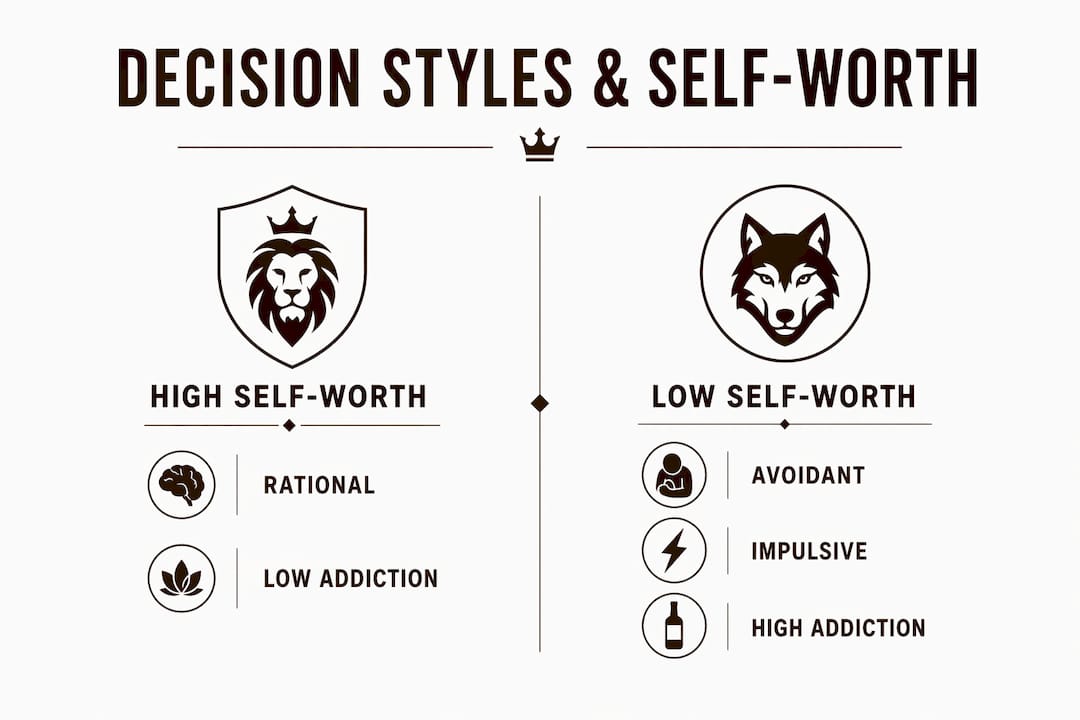
People with higher self-worth tend to use a rational decision-making style. They gather information, weigh options, and act with intention. People with lower self-worth lean toward avoidant, impulsive, or dependent styles. They delay decisions, act on emotion, or hand authority to others because they do not trust their own judgment.

| Decision style | Self-worth level | Addiction tendency |
|---|---|---|
| Rational | High | Low |
| Avoidant | Low | Moderate to high |
| Impulsive | Low | High |
| Dependent | Low | Moderate |
Pro Tip: Notice which style you use most often. Avoidance and impulsivity are not personality traits. They are signals that your sense of worth needs attention.
Only 34% of employees in one workplace study demonstrated the confidence and self-esteem needed for assertive decisions, even when they had the technical skills to do the job. Skill without self-worth produces hesitation. That gap costs people promotions, relationships, and opportunities every day.
What role does confidence play in risk-taking and choice framing?
Self-worth does not affect all decisions equally. Research shows that framing-contingent effects of self-worth on risk-taking mean your confidence level influences choices differently depending on whether a situation is framed as a potential gain or a potential loss.
When a decision is framed as a gain (“What could I win here?”), higher self-worth pushes people toward bolder, more confident choices. When the same decision is framed as a loss (“What could I lose here?”), self-worth has less influence. Fear takes over instead. This explains why people who feel good about themselves still freeze when they focus on what they might lose.
This framing effect shows up in everyday life more than most people realize. Common contexts where framing shapes choices include:
- Career moves: Applying for a promotion feels different when you focus on the opportunity versus the risk of rejection.
- Relationships: Expressing a need feels different when you frame it as connection versus vulnerability.
- Financial decisions: Investing feels different when you think about growth versus the possibility of loss.
- Health choices: Starting a new routine feels different when you focus on energy gained versus habits broken.
The practical takeaway is this: when you notice yourself stuck on the loss side of a decision, your self-worth is likely not the problem. Your framing is. Shifting the question from “What if I fail?” to “What do I gain by trying?” can change the entire decision.
Why does low self-worth lead to indecision and fear-based choices?
Low self-worth does not just make decisions harder. It rewires the process entirely. Self-esteem explains 35%.0846) of the variance in indecisiveness, based on a study of 500 undergraduate students using the Frost Indecisiveness Scale and the Rosenberg Self-Esteem Scale. That is a significant share of your ability to decide, driven entirely by how you feel about yourself.
When self-worth is low, decision-making shifts from intentional to reactive and fear-based, regardless of the objective facts in front of you. Your brain stops asking “What is the right choice?” and starts asking “What choice will keep me safe from judgment or failure?” Those are very different questions, and they produce very different outcomes.
The everyday signs of fear-based decision-making are easy to miss because they look like caution. Overanalyzing a simple email before sending it. Asking three people for their opinion before making a personal choice. Accepting a job, relationship, or situation that feels “fine” because you do not believe you deserve better. These are not quirks. They are the direct effects of self-image on choices.
Internal narratives about capability act as filters that shape the decision process beyond logical reasoning. You can have all the information you need and still choose poorly if the story you tell yourself says you are not capable, not worthy, or not enough. That filter is invisible but constant.
Pro Tip: When you catch yourself overanalyzing or seeking reassurance, pause and ask: “Am I making this decision from logic or from fear?” The answer tells you more about your self-worth than any quiz ever could.
How can you strengthen self-worth to make better decisions?
Self-worth is not the same as confidence. Confidence is situational. It rises and falls with performance. Self-worth is the baseline belief that you have value regardless of outcomes. Building confidence without addressing core worth often fails because the foundation is missing. You can fake confidence in a meeting and still go home and make a fear-based choice about your relationship.
Better information alone rarely improves decisions if self-worth is low. The real turning point is willingness. Willingness is an internal shift, not a skill you learn. It is the moment you decide that your growth matters more than your comfort. Without it, knowledge stays theoretical.
The most effective way to build self-worth is through consistent, small actions that prove to yourself that your judgment is trustworthy. Building self-trust via small, low-stakes decisions develops the internal muscle you need before tackling major life choices. Start with decisions that feel manageable, and honor them without second-guessing.
Practical exercises to strengthen self-worth and improve decision-making:
- Make one small decision daily without asking for input. What to eat, which route to take, which task to start first. Each decision you own builds trust in your own judgment.
- Write down three choices you made this week that reflected your values. This trains your brain to recognize that you already make good decisions.
- Set one boundary this week and hold it. Boundaries are decisions. Holding them tells your nervous system that your needs matter.
- Identify your internal narrative before a big decision. Write it down. Ask whether that story is fact or fear.
- Weigh advice without outsourcing authority. Weighing advice without outsourcing authority strengthens the alignment between self-worth and decision-making. Listen to others, then decide for yourself.
Self-worth improvements drive a shift from fear-driven to intentional decision-making. That shift requires ongoing honest self-reflection, not a single breakthrough moment.
Key Takeaways
Self-worth is the single most consistent internal factor shaping whether your decisions come from intention or fear, and building it requires small, honest actions repeated over time.
| Point | Details |
|---|---|
| Self-worth predicts decision style | Research shows self-esteem and rational decision-making explain 46% of addiction-related choice variance. |
| Framing changes the impact | Self-worth influences risk-taking more in gain-framed decisions than in loss-framed ones. |
| Low self-worth drives indecision | Self-esteem accounts for 35% of indecisiveness variance, based on 500 students studied. |
| Confidence is not enough | Building confidence without addressing core self-worth consistently fails to improve decisions. |
| Small decisions build self-trust | Practicing low-stakes decisions without seeking validation develops the judgment needed for bigger choices. |
What I’ve learned about self-worth and the choices that define you
The most common mistake I see is people waiting to feel confident before they act. They think confidence is the prerequisite. It is not. Self-worth is. And self-worth does not arrive before the decision. It grows because of the decision.
I spent years watching people with impressive skills and real talent make small, fearful choices. Not because they lacked information. Because they did not believe they deserved the outcome they were reaching for. That belief is quiet. It does not announce itself. It just filters everything.
The misconception that bothers me most is the idea that you need to “fix yourself” before you can make better choices. You do not. You need to make one honest choice, from where you are right now, and let that be the proof. Mistakes are not evidence that you chose wrong. They are evidence that you chose at all. That is growth.
Your internal dialogue is the loudest voice in every decision room. Learning to question it, not silence it, is where real change starts. Be direct with yourself. Be kind with yourself. Those two things together are what self-worth actually looks like in practice.
— Kofi
Wear the reminder every day
Mrhappinessofficial was built for people who already know their worth and want to live like it. The collection is not about labels or status. It is about identity.

The “Be Unforgettable” Hoodie and the Signature Zip Hoodie are designed to carry a message you can wear every day. Premium quality. Clean design. A reminder that who you are is enough. When your mindset is your foundation, what you wear reflects that. Shop the full Signature Collection and wear what you stand for.
FAQ
What is self-worth and how does it differ from self-esteem?
Self-worth is the core belief that you have inherent value as a person, regardless of performance or outcomes. Self-esteem is more situational and rises or falls based on achievements, while self-worth remains the deeper, more stable foundation beneath it.
How does low self-worth affect decision-making?
Low self-worth shifts decision-making from intentional to reactive and fear-based, causing people to avoid choices, seek excessive reassurance, or accept less than they deserve. Research confirms that self-esteem explains 35% of the variance in indecisiveness.
Can self-worth change your choices over time?
Self-worth improvements drive a measurable shift from fear-driven to intentional decision-making. Practicing small, honest decisions without external validation builds self-trust and gradually changes the quality of larger life choices.
Why does confidence alone not improve decision-making?
Technical skill and surface confidence do not guarantee assertive decisions if core self-worth is underdeveloped. Research found that only 34% of employees demonstrated the self-esteem needed for assertive workplace decisions, even when they had the required skills.
What is the fastest way to start building self-worth?
The most effective starting point is making one small decision daily without seeking input and honoring it. This builds the self-trust muscle that underpins better decisions over time, according to research on self-esteem and accountability in decision-making.