
How Immigrant Entrepreneurs Redefine Success in America
How immigrant entrepreneurs redefine success beyond profit
Immigrant entrepreneurs don’t just build businesses. They rebuild what success means. Their definition extends past revenue and market share to include community development, cultural preservation, and lasting legacy. That shift isn’t philosophical posturing. It’s baked into how they operate from day one.
- Resilience as a foundation. Migration demands constant adaptation. That muscle carries directly into business, producing founders who treat uncertainty as a design condition, not a setback.
- Innovation through cultural bridging. Immigrant founders often spot gaps that legacy businesses miss entirely, because they hold two or more cultural frames at once. Products and services emerge from that overlap.
- Community as the growth engine. Rather than the solo-visionary model, many immigrant entrepreneurs embed their ventures inside diaspora networks and local communities, creating trust-based ecosystems that sustain growth.
- Social impact as a core metric. Job creation, neighborhood revitalization, and expanded consumer diversity are treated as measures of success alongside profit.
- Legacy over exit. Many immigrant founders build with generational continuity in mind, not a five-year acquisition timeline.
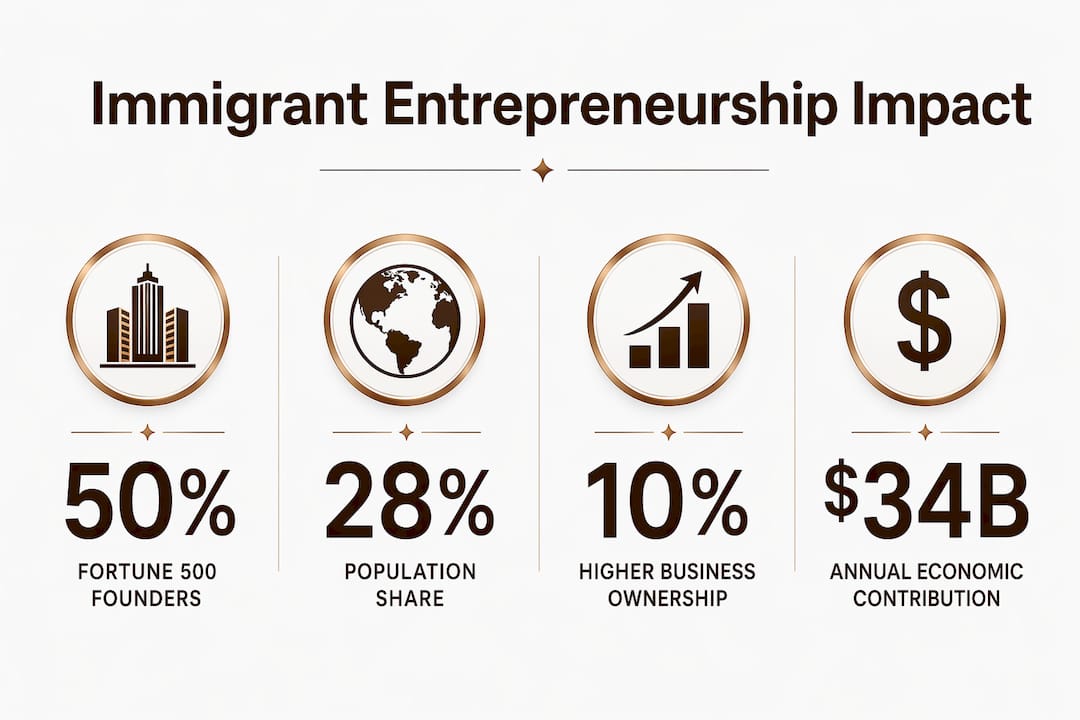
Immigrants and their children make up about 28% of the U.S. population, yet they founded nearly 50% of Fortune 500 companies and led 80% of billion-dollar startups. That gap between population share and entrepreneurial output tells you everything about how differently they approach the game.
What’s driving the surge in immigrant entrepreneurship right now
The numbers behind immigrant entrepreneurship in 2026 are hard to ignore. Immigrant-founded firms now make up nearly 50% of Fortune 500 companies, a new high. Immigrants also represent 23.6% of all U.S. entrepreneurs nationwide, with even higher concentrations in sectors like accommodations and food service, where they account for roughly one-third of business owners.
Several forces converge to produce these outcomes:
- Personal pain points become market opportunities. Immigrant founders often build because no existing product served their community. That specificity creates loyal early adopters and defensible niches.
- Diaspora networks as distribution. Trust-based networks within immigrant communities function as ready-made distribution channels, customer bases, and talent pools simultaneously.
- Plural identity as creative fuel. Immigrant entrepreneurs reframe identity as an asset rather than a liability, drawing on layered cultural histories to create products their new markets have never encountered.
- Venture capital following the signal. Venture capital investment in immigrant-founded startups has grown substantially in recent years. Immigrant founders have co-founded a majority of U.S. unicorn startups, with their share increasing over the past decade.
- Rapid adaptation to disruption. Immigrant founders develop what one researcher described as “muscle memory for instability.” During the COVID-19 pandemic, immigrant-led businesses were often faster to reconfigure supply chains and pivot delivery models than their native-born counterparts.
The pattern isn’t accidental. Immigrants are about 10% more likely to own businesses than native-born Americans, and that gap reflects structural motivations as much as individual ambition.
Pro Tip: If you’re studying immigrant entrepreneurship models, look at how founders use diaspora networks not just for customers but for co-founders, suppliers, and early advisors. That relational architecture is often what separates durable businesses from short-lived ones.

What actually holds immigrant entrepreneurs back
The barriers are real, structural, and often invisible to outsiders. Understanding them matters because they shape which businesses get built, how fast they scale, and who gets left behind.
- Visa and legal uncertainty. Immigrant founders frequently operate under visa conditions that restrict their ability to pivot, hire, or raise capital freely. Legal fees alone can run into the tens of thousands of dollars, and the uncertainty those processes create directly undermines investor confidence.
- Funding gaps. Angel funding to immigrant founders averages 34% less than comparable native-born peers receive, even when business plans are equivalent. That disparity compounds at every subsequent funding round.
- Exclusion from traditional networks. Access to elite professional networks, alumni connections, and legacy investor relationships often depends on social capital that takes decades to build. Immigrant founders frequently start without it.
- Cultural adjustment and discrimination. The psychological weight of navigating a new culture while building a business is rarely quantified but consistently reported. Discrimination in hiring, lending, and partnership conversations adds friction at every stage.
- Legislative gaps. The U.S. currently lacks a dedicated startup visa pathway. The International Entrepreneur Parole program through USCIS offers a partial bridge, but it is discretionary, time-limited, and subject to policy shifts that create planning uncertainty for founders and their investors.
These aren’t soft obstacles. A 34% funding gap and five-figure legal costs represent concrete capital disadvantages that shape which ideas get funded and which founders burn out before their businesses find traction.
The economic and social impact immigrant entrepreneurs generate
The contribution is measurable, and it runs deeper than GDP figures. Immigrant small businesses employ millions of American workers and have revitalized neighborhoods and industries across the country. The American Immigration Council reports that 46.2% of Fortune 500 companies in 2025 were founded by immigrants or their children, including companies like Amazon, Apple, and NVIDIA, co-founded by Jensen Huang, who immigrated from Taiwan as a child.
The social dimensions are equally significant:
- Neighborhood revitalization. Immigrant-owned businesses frequently anchor commercial corridors in underserved areas, creating foot traffic, employment, and economic stability where legacy investment has retreated.
- Cultural preservation and expansion. Immigrant entrepreneurs introduce products, foods, and services that diversify American consumer culture and preserve heritage practices that would otherwise disappear.
- Shifting social narratives. When immigrant-founded companies reach scale, they reshape public perception of what immigrants contribute. NVIDIA’s dominance in AI hardware is inseparable from Jensen Huang’s story. Sirius XM’s rise in satellite media reflects the vision of Canadian-born co-founder David Margolese.
- Consumer diversity and market expansion. Immigrant entrepreneurs often unlock entirely new consumer segments, serving communities that mainstream brands have historically ignored or misunderstood.
- Inclusive economic models. Many immigrant-founded businesses prioritize hiring within their communities, creating pathways for workers who face their own barriers to entry in the formal labor market.
The MIT research on immigrant firm formation confirms that immigrants are more likely to start firms and create jobs than native-born Americans. That output compounds across decades into the structural fabric of the American economy.
What policies and programs are actually supporting immigrant founders
Support exists, but it’s fragmented. The most effective interventions combine legal clarity, capital access, and community infrastructure.
- International Entrepreneur Parole. The USCIS International Entrepreneur Parole program allows qualifying founders to remain in the U.S. to grow their companies, but its discretionary nature and limited duration make it an incomplete solution for long-term planning.
- The Startup Act (H.R. 962). Introduced in Congress, this legislation proposed a dedicated startup visa for immigrant founders who meet capital-raise and job-creation thresholds. It has not passed, but it remains the clearest legislative template for a dedicated pathway.
- Immigrant-focused accelerators. Demand for immigration and business support services has tripled since 2024, reflecting how quickly the ecosystem is growing. Dedicated funds targeting immigrant-founded startups have raised tens of millions in early-stage capital rapidly.
- SBA resources and nonprofit hubs. The Small Business Administration’s research on immigrant capital access has informed nonprofit lending programs that specifically address the funding gap immigrant founders face.
- Private sector and philanthropic investment. Corporate venture arms and philanthropic foundations have increasingly targeted immigrant-founded startups, recognizing both the financial returns and the social impact those investments generate.
- Community-led advocacy. Immigrant entrepreneur networks have become effective policy advocates, translating founder experiences into legislative testimony and public campaigns that shift the conversation from charity to economic contribution.
The gap between what exists and what’s needed remains wide. A dedicated startup visa, expanded access to SBA-backed lending, and sustained accelerator funding would collectively address the three biggest structural barriers: legal status, capital, and network access.
How authentic stories and community focus shift the American Dream
The most durable immigrant-founded businesses aren’t built on product features alone. They’re built on identity, narrative, and belonging. That’s a different competitive moat than most business schools teach.
- Narrative as brand infrastructure. Authentic immigrant stories build consumer empathy at a depth that conventional marketing rarely reaches. These stories act as maps of possibility, connecting buyers to founders through shared experiences of displacement, reinvention, and pride.
- Cultural products repositioned as premium. Jing Gao’s Fly By Jing is the clearest recent example. Chinese cuisine had been systematically undervalued in U.S. markets for decades. Fly By Jing repositioned it at premium price points through brand design, storytelling, and unapologetic cultural confidence. The market followed.
- Relational capital as a competitive advantage. Community embeddedness gives immigrant founders something the solo-visionary model can’t replicate: trust networks that function as distribution, talent, and resilience simultaneously. These models tend to be less extractive and more regenerative than conventional growth-at-all-costs structures.
- Redefining the American Dream itself. The traditional framing centers individual financial ascent. Immigrant entrepreneurs increasingly build enterprises that reconnect and uplift diverse communities, treating social belonging and cultural continuity as success metrics alongside revenue.
- Identity integration as a business model. Founders who integrate rather than suppress their cultural identities create products that carry meaning beyond utility. That meaning commands loyalty, premium pricing, and word-of-mouth that paid acquisition can’t buy.
- Prosocial storytelling changes public perception. Narratives that frame immigrant entrepreneurs as people overcoming real challenges encourage positive social attitudes and reshape how communities perceive immigration itself. The business and the social impact become inseparable.
The same philosophy runs through what Mrhappinessofficial stands for. Special isn’t priced or labeled. It’s who you are. That conviction, that identity is the asset, is exactly what immigrant entrepreneurs have been proving in markets across America for generations. Brands built on custom coffee branding for entrepreneurs and other authentic storytelling models show how deeply consumers respond when a founder’s real identity shapes every product decision.
Pro Tip: When building a brand around cultural identity, resist the urge to soften the edges for mainstream appeal. The specificity is the differentiator. Fly By Jing didn’t succeed by making Chinese flavors more familiar. It succeeded by making them undeniable.

The immigrant entrepreneur’s playbook, resilience, relational capital, cultural authenticity, and community focus, isn’t a niche strategy. It’s a model for building businesses that last. And it’s rewriting what American success looks like, one founder at a time.
Wear the reminder
Identity is the asset. That’s what immigrant entrepreneurs have proven, and it’s what Mrhappinessofficial was built around.

The “Be Unforgettable” Hoodie carries that same conviction. Premium construction. Clean design. A reminder you wear every day that who you are is enough. No label required.
Browse the full Mrhappinessofficial signature collection and wear what you stand for.
Key Takeaways
Immigrant entrepreneurs redefine success by measuring outcomes in community impact, cultural legacy, and relational capital alongside financial returns, producing businesses that outperform and outlast.
| Point | Details |
|---|---|
| Outsized entrepreneurial output | Immigrants and their children founded nearly 50% of Fortune 500 companies and led 80% of billion-dollar startups, despite making up about 28% of the U.S. population. |
| Venture capital momentum | Venture capital investment in immigrant-founded startups has grown substantially in recent years. |
| Persistent funding gap | Angel funding to immigrant founders averages 34% less than comparable native-born peers receive, compounding at every funding stage. |
| Community as competitive advantage | Relational capital and diaspora trust networks function as distribution, talent, and resilience infrastructure that conventional models cannot replicate. |
| Cultural identity drives premium value | Founders who integrate cultural heritage into brand identity, like Fly By Jing, command premium pricing and consumer loyalty that paid acquisition cannot match. |