
Hoodie vs Sweatshirt: Which Should You Buy?
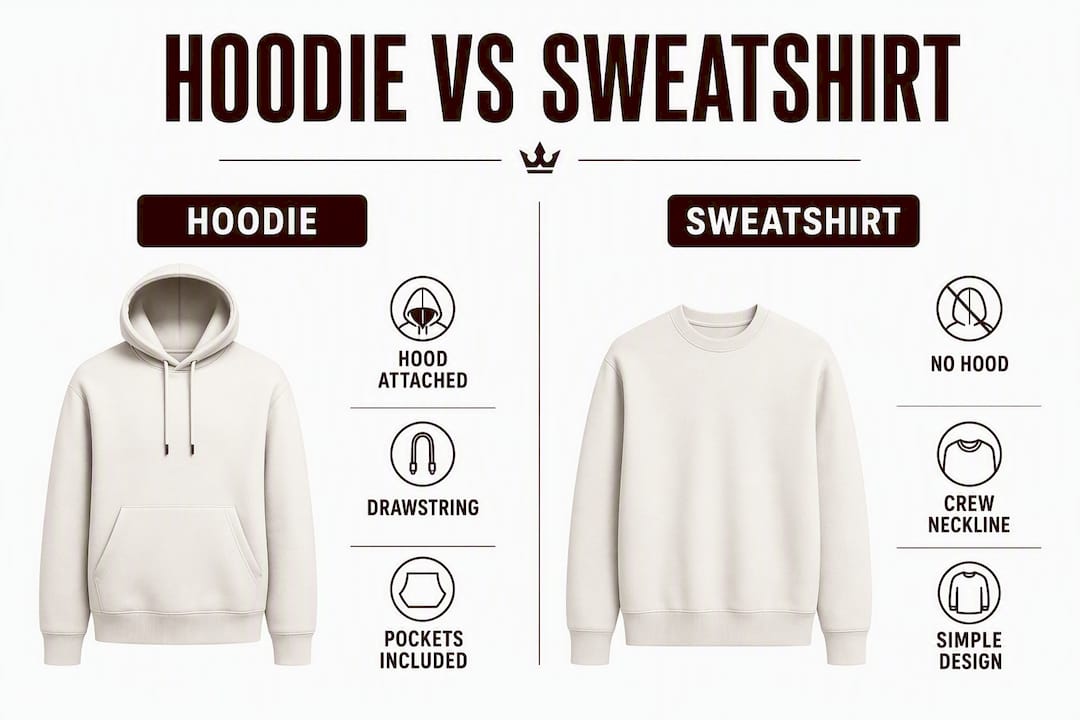
A hoodie is a sweatshirt with an attached hood. That single structural detail changes warmth, pocket design, and how the garment layers. If you only need the short answer: choose a hoodie for outdoor warmth and casual streetwear looks; choose a crewneck sweatshirt when you want a cleaner silhouette for layering under jackets or dressing up slightly.
Three things to check before buying:
- Hood present? Yes = hoodie. No = sweatshirt.
- Closure type: Pullover or zip-up (both can be hoodies when a hood is attached).
- Fabric weight (G/M²): Heavier means warmer. Lighter means more breathable.
Pro Tip: Check the product page for G/M² weight and whether the interior is “brushed” or “fleece-lined.” Those two details tell you more about warmth than the product name alone.
Table of Contents
- How do hoodies and sweatshirts actually compare?
- What are the main types of hoodies and sweatshirts?
- How do fabrics and weight affect warmth and comfort?
- When should you wear a hoodie vs a sweatshirt?
- How do pockets, zippers, and fit change the way you use each garment?
- How do you care for hoodies and sweatshirts to make them last?
- What should you check before adding a hoodie or sweatshirt to cart?
- Key Takeaways
- The case for knowing exactly what you’re buying
- Mrhappinessofficial builds hoodies worth checking the spec on
How do hoodies and sweatshirts actually compare?
The table below maps the differences that matter most when shopping.
| Feature | Hoodie | Sweatshirt |
|---|---|---|
| Hood | Attached, with drawstring | None — crew or round neckline |
| Closure | Pullover or zip-up | Pullover only |
| Pockets | Kangaroo pocket (front pouch) or side pockets | Smooth front, sometimes side pockets |
| Warmth | Higher — hood covers head and neck | Good warmth, slightly less coverage |
| Formality | Casual, streetwear, outdoor | More versatile; easier to dress up |
| Silhouette | Relaxed, bulkier at the collar | Cleaner, slimmer at the neck |
| Layering | Harder under structured outerwear | Fits easily under blazers or jackets |
| Care | Cold wash, low heat; zipper hardware needs attention | Cold wash, low heat; simpler care |
Hoodies generally provide superior warmth because the hood adds coverage around the head and neck that a crewneck cannot match. The kangaroo pocket on most hoodies also affects print placement — centered graphics work better on the smooth front of a sweatshirt, while a hoodie’s pouch pocket splits the lower chest.
What are the main types of hoodies and sweatshirts?
Sweatshirt means a pullover top with no hood, typically a crew or round neckline. Warm, simple, and clean-fronted.
Hoodie means any sweatshirt-style top with an attached hood. A zip-up is still a hoodie as long as the hood is present — the zipper is a functional variation, not a category change.
Common subtypes:
- Crewneck sweatshirt: Round neckline, no hood, smooth front. The most versatile sweatshirt style for layering.
- Pullover hoodie: No zipper, hood attached, usually a kangaroo pocket. Classic casual silhouette.
- Zip-up hoodie: Full-length zipper, hood attached. Easy to layer and remove; adjustable ventilation.
- Quarter-zip: A partial zipper at the collar — no hood, sits between a sweatshirt and a performance top.
- Cropped hoodie or sweatshirt: Shorter hem, sits at or above the waist. Popular in streetwear and athleisure.
- Oversized fit: Either style cut with extra room through the body and shoulders for a relaxed, streetwear-forward look.
Zip-up hoodies add adjustable ventilation and easy on/off convenience, while pullover hoodies and crewneck sweatshirts maintain a continuous chest panel — better for large graphics and a cleaner front.

How do fabrics and weight affect warmth and comfort?
Heavier fabrics with brushed interiors trap more heat. Lighter, unbrushed fabrics breathe better and drape more crisply. That’s the whole equation.
G/M² explained: Grams per square meter measures how dense the fabric is. Practical ranges:
- Lightweight (180–260 G/M²): Breathable, good for layering or mild weather.
- Midweight (270–340 G/M²): The everyday sweet spot — warm enough for fall, not too heavy for spring.
- Heavyweight (350–500+ G/M²): Substantial feel, serious cold-weather insulation. Specialty hoodies at ~500 G/M² are built for maximum warmth and durability in daily wear.
Common fabrics:
- Fleece (polar fleece): Synthetic, lightweight for its warmth, quick-drying. Brushed interior traps air and insulates well.
- French terry: Looped interior, smooth exterior. Breathable and slightly lighter than fleece — good for transitional weather.
- Cotton blends (cotton/polyester): The most common construction. Soft, holds shape, resists shrinkage better than 100% cotton.
- Polyester blends: More durable, moisture-wicking, less prone to pilling over time.
Brushed interior fleece raises fibers to trap air and increase insulation; unbrushed interiors have a crisper drape and better breathability for active use.
Pro Tip: On any product page, look for the words “brushed,” “fleece-lined,” or “heavyweight” in the fabric description. If those words aren’t there, assume a lighter, less insulating construction.
When should you wear a hoodie vs a sweatshirt?
Streetwear and casual categories favor hoodies for their relaxed silhouette and hood utility. Sweatshirts earn their place when a cleaner look or easier layering is the priority.
Outfit examples:
- Hoodie + joggers: The streetwear baseline. Pair the “Mind Over Noise” Joggers with a heavyweight pullover hoodie for a complete, intentional look.
- Crewneck sweatshirt + slim trousers: Cleaner than a hoodie, works for campus or a casual Friday.
- Zip-up hoodie + tee + chinos: Layered and practical for travel or commuting — unzip when warm, zip when cold.
- Oversized hoodie + biker shorts: Athleisure. The volume contrast is the point.
- Crewneck sweatshirt + blazer: The sweatshirt’s smooth neckline sits under a structured jacket without bunching.
- Cropped sweatshirt + high-waist pants: Contemporary and proportional — works for gym-to-street transitions.
- Heavyweight hoodie alone in cold weather: At 350 G/M² and above, a quality hoodie functions as a standalone outer layer in mild cold.
Seasonal guidance: French terry and lightweight cotton blends work well in spring and fall. Brushed fleece and heavyweight cotton constructions carry you through winter. The choice between the two garments usually comes down to intended use — gym training, outdoor warmth, or polished layering each call for a different answer.
How do pockets, zippers, and fit change the way you use each garment?
Pockets, zips, and drawstrings change utility and silhouette immediately. A kangaroo pocket warms hands and carries small items, but it adds bulk to the front and interrupts print placement. Side seam pockets keep the front clean while still offering storage. No pockets at all gives the smoothest front panel.
Key functional details:
- Kangaroo pocket: Signature hoodie feature. Practical for hands and small items; affects how graphics sit on the chest.
- Side seam pockets: Available on some sweatshirts and hoodies. Cleaner front, similar utility.
- Full zip closure: Allows full ventilation, easy layering over other tops, and quick removal. The Signature Zip Hoodie from Mrhappinessofficial is built for exactly this kind of versatility.
- Drawstring hood: Adjusts fit around the face; adds a small amount of bulk at the collar when not in use.
- Ribbed cuffs and hem: Keep the garment in place and reduce heat loss at the wrists and waist.
Fit and sizing: A relaxed or oversized fit layers easily over a base layer tee and reads as intentional streetwear. A fitted silhouette sits cleanly under a jacket but leaves less room for layering underneath. If you plan to wear the piece over other tops in cold weather, size up one.

How do you care for hoodies and sweatshirts to make them last?
Gentle care preserves fabric, fit, and color. High heat is the main enemy — it causes shrinkage, pilling, and color fade faster than almost anything else.
Care do’s and don’ts:
- Do wash cold or on a gentle cycle.
- Do turn garments inside out before washing to protect prints and surface fibers.
- Do use a mild, color-safe detergent.
- Do tumble dry on low heat or air dry flat to hold the shape.
- Don’t use bleach — it breaks down cotton fibers and fades color.
- Don’t dry on high heat — this is the fastest route to shrinkage.
- Don’t wring out heavy cotton pieces; press out water gently instead.
Cold wash, gentle cycle, and low-heat drying are the standard recommendations for both garment types. For zip-up hoodies, zip the zipper before washing to prevent the hardware from snagging other fabric.
Durability signals worth checking before you buy: tight stitch density at seams, reinforced ribbing at cuffs and hem, and double-stitched pocket openings. Pilling is normal on cotton-heavy fabrics over time — a fabric shaver removes surface pills without damaging the garment.
Pro Tip: Pilling happens fastest where friction is highest — under the arms and across the chest. Washing inside out and skipping the dryer on high heat slows it down significantly.
What should you check before adding a hoodie or sweatshirt to cart?
A short checklist works better than guessing. Run through these before buying:
- Intended use first. Outdoor warmth? Go heavyweight with a brushed interior. Layering under a jacket? Go midweight crewneck. Active use? Lightweight French terry or polyester blend.
- Check for a hood. If you want one, confirm it has a drawstring. If you don’t want bulk at the collar, go crewneck.
- Decide on closure. Pullover for a cleaner front and better print placement. Zip-up for ventilation and easy layering.
- Read the fabric spec. Look for G/M² weight, fiber composition (cotton/poly ratio), and whether the interior is brushed or fleece-lined.
- Check pocket placement. Kangaroo pocket for hand warmth and utility. Side pockets or no pockets for a cleaner front.
- Assess fit and sizing guidance. Oversized for streetwear. True-to-size for a fitted layer. Size up if you plan to wear it over other tops.
- Read care instructions. Machine wash cold and low-heat dry is the standard. Anything requiring dry clean only adds long-term cost.
Pro Tip: For everyday cold-weather wear, a midweight (280–320 G/M²) brushed-interior hoodie covers most situations. For cleaner layering under structured outerwear, a midweight crewneck sweatshirt is the better call.
Key Takeaways
A hoodie is a sweatshirt with an attached hood — that structural difference drives every choice around warmth, pockets, layering, and style.
| Point | Details |
|---|---|
| Core difference | A hood defines a hoodie; no hood means a sweatshirt, regardless of fabric or weight. |
| Warmth advantage | Hoodies cover the head and neck, giving more insulation than a crewneck in cold weather. |
| Layering advantage | Crewneck sweatshirts fit cleanly under blazers and jackets without collar bulk. |
| Fabric weight matters | Check G/M² on the product page — 350–500 G/M² for serious warmth, 270–340 G/M² for everyday wear. |
| Mrhappinessofficial pick | The “Be Unforgettable” Hoodie is a heavyweight, premium construction built for daily streetwear wear. |
The case for knowing exactly what you’re buying
Most people treat the hoodie vs sweatshirt question as a style preference. It’s actually a functional decision. The hood changes warmth. The zipper changes how you layer. The pocket changes where a graphic can live. These aren’t minor details — they determine whether a piece works for the situation you bought it for.
What gets underestimated is how much the interior construction matters relative to the exterior look. Two hoodies at the same price point can feel completely different if one has a brushed fleece interior and the other doesn’t. The product photo won’t show that. The G/M² weight and the word “brushed” in the spec will. Most shoppers skip those details and then wonder why the piece feels thin or stiff after one wash.
The other thing worth saying plainly: there’s no universally better garment. A crewneck sweatshirt isn’t a lesser hoodie — it’s a different tool. For anyone building a streetwear wardrobe with intention, having one of each in a midweight construction covers almost every scenario from a cold commute to a casual dinner.
Mrhappinessofficial builds hoodies worth checking the spec on
Premium construction at a price that doesn’t require a second mortgage. That’s the actual pitch.
Mrhappinessofficial makes heavyweight hoodies designed for daily wear — the kind where the G/M² weight, brushed interior, and stitch quality are listed on the product page because they matter. The “Be Unforgettable” Hoodie is built for the streetwear-to-everyday use case this guide covers: substantial fabric, clean construction, and a silhouette that holds its shape wash after wash.

For zip-up versatility, the Signature Zip Hoodie gives you the layering flexibility and adjustable ventilation that a pullover can’t. Pair either with the “Mind Over Noise” Joggers for a complete, intentional set.
Check the product specs. Confirm the weight and interior. Then decide. Browse the full Mrhappinessofficial collection and find the piece that fits the way you actually live.