
Express Identity Through Your Daily Choices
Your identity isn’t declared. It’s built, quietly, one choice at a time. The clothes you reach for at 7 AM, the words you choose in a conversation, the content you scroll past or stop on — each of these is a vote cast for the person you’re becoming. Expressing identity through daily choices isn’t a philosophy reserved for self-help circles. It’s the actual mechanism behind who you are.
How daily choices express and shape personal identity

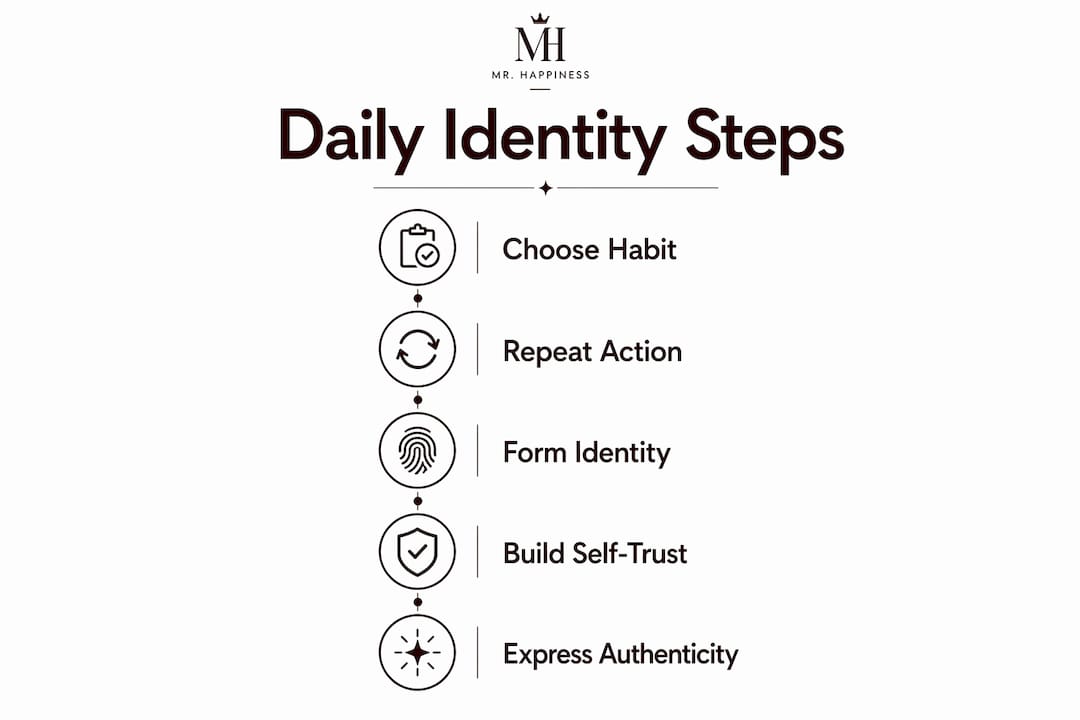
Every decision you make is a small act of authorship. Daily habits function as iterative identity votes, where frequent, small behavioral choices collectively build personal identity over time. Nothing dramatic required. No reinvention moment. Just repetition, accumulating into a self.
The areas where this plays out most visibly:
- Appearance: What you wear signals values before you speak a word
- Language and tone: How you communicate shapes how others read you and how you read yourself
- Morning routine: The first hour sets a pattern for the rest of the day
- Social interactions: Who you spend time with and how you engage defines your social self
- Digital behavior: What you post, follow, and share constructs a visible identity layer
- Spending habits: Where money goes reflects what actually matters to you
- Creative pursuits: Writing, music, art, or movement all express something words often can’t
Intentionality is the difference between drifting and authoring. When choices are made consciously, they stop being reactions and start being statements.
What types of identity do your choices actually shape?
Identity isn’t one thing. It’s layered, and different daily decisions touch different layers.
- Personal identity: The private self. How you see yourself when no one is watching. Shaped by habits, values, and the internal narrative you reinforce daily.
- Social identity: The self defined by group membership — culture, community, family, profession. Choices about language, dress, and association signal belonging or distinction.
- Role-based identity: The self tied to function — parent, professional, athlete, creator. Daily actions within each role either reinforce or erode that self-concept.
- Aspirational identity: The self you’re moving toward. Choices here are forward-facing: the book you read, the skill you practice, the standard you hold yourself to.
Each layer responds to different kinds of decisions. A morning workout reinforces both personal and role-based identity simultaneously. A deliberate wardrobe choice can express social and aspirational identity in a single moment. The layers aren’t separate — they overlap, and conscious choices tend to strengthen more than one at once.
Concrete choices that actively express who you are
Appearance is the most immediate signal. Clothing, accessories, and grooming communicate identity before a single word is exchanged. A vintage jacket, a minimalist wardrobe, or a bold graphic tee each carries a message. Research on choice set size confirms that having more options makes individuals perceive their choices as more self-expressive, increasing the likelihood they’ll share those choices publicly. The symbolic weight of a decision grows when it feels chosen rather than defaulted into.
Beyond appearance, these domains carry significant identity weight:
- Habits and routines: Morning rituals, exercise patterns, and sleep schedules reveal priorities and reinforce self-concept
- Communication style: Word choice, directness, humor, and tone all project identity consistently
- Social media presence: The content shared, the accounts followed, and the conversations joined build a public identity layer that feeds back into the private one
- Consumption choices: Music, food, brands, and media preferences signal values and cultural alignment
Pro Tip: Pick one small habit that reflects who you want to be and repeat it daily for 30 days. Not for results. For the evidence it creates. Each repetition tells your mind, “This is who I am.”
Fashion, specifically, is one of the most direct forms of identity through style. What you wear doesn’t just express mood — it communicates history, community, and values without a single word spoken.

What psychology and behavioral science say about identity formation
The brain is not a passive observer of your choices. It actively rewires around them. Conscious practices like mindfulness, therapy, and exercise increase brain-derived neurotrophic factor (BDNF) and reshape neural pathways, making identity-consistent choices progressively easier over time. The more you act like the person you want to be, the more your brain supports that pattern.
Research found that daily habits play a significant role in shaping positive versus negative identity outcomes, with goal-directed behavior being the strongest predictor, followed by morning routine consistency and mindful decision-making.
Identity also emerges from repeated actions in a way that builds self-trust. Each time you follow through on a choice that aligns with your intended self, the evidence accumulates. The story you tell yourself begins to shift. This is not motivation-dependent. It’s evidence-dependent.
Psychological research on authentic identity expression shows that consistency in quiet, familiar choices often communicates true authenticity better than bold performance. The person who reads every morning, trains without announcing it, and dresses with intention is expressing identity more clearly than someone performing identity for an audience.
Strategies for making conscious daily choices to shape identity
The most effective approach starts with deciding who you want to be, not what you want to achieve. Identity-based habits work because they flip the direction: instead of chasing outcomes, you build the identity of the person who naturally produces those outcomes.
Start with identity, not goals. Ask: “Who is the type of person I want to become?” Then ask what that person does daily. Work backward from identity to action.
Cast small votes consistently. A single choice means little. Hundreds of repeated choices mean everything. Writing one paragraph daily makes you a writer faster than announcing you’re writing a novel. The 2-Minute Rule applies here: start so small the action is impossible to skip.
Rate your decisions on a personal-to-social scale. A practical exercise for increasing identity awareness involves rating daily decisions on a scale from purely personal desire to purely social pressure. Decisions consistently landing near the social end signal that identity is being outsourced. Awareness of that pattern is the first step toward reclaiming it.
Prioritize morning architecture. Structured morning habits function as a platform for the rest of the day. Goal-directed behavior and morning routine consistency are the two strongest independent predictors of positive identity outcomes, according to the 2026 research cited above.
View identity as fluid, not fixed. Fluid identity is rewritten daily. Treating it as permanent creates paralysis. Treating it as a living document creates momentum. Small shifts compound without triggering the identity loss that comes from radical reinvention.
Real examples of identity expression through daily habits
A person who trains before sunrise isn’t just building fitness. They’re casting a daily vote for discipline, and over time, “I work out” becomes “I am someone who trains.” The identity precedes the result.
Someone who chooses to dress with intention each morning — not for others, but for themselves — is practicing a form of self-respect that compounds. Mrhappinessofficial was built around exactly this idea: that what you put on your body is a daily reminder of who you are, not a performance for anyone else. The Mindset Over Opinion Pants aren’t just apparel. They’re a daily prompt.
A creator who writes 200 words every morning, without exception, builds a writer’s identity long before any external validation arrives. The habit is the proof. The external recognition follows, but the identity doesn’t depend on it.
Social media offers a particularly visible case study. When someone curates their feed deliberately — following accounts that challenge their thinking, muting content that drains them — they’re shaping the information environment that shapes their worldview. That’s identity work, done daily, in small increments.
How social and cultural context shapes identity expression through daily decisions
No choice is made in a vacuum. Culture sets the frame for which choices feel expressive and which feel invisible. Research across six studies found that choice set size affected perceived self-expression significantly in American contexts but did not produce the same effect in India, where more interdependent models of agency are culturally dominant. In the United States, self-expression through choice is not just permitted — it’s culturally expected and reinforced.
Social context adds another layer. The reactions of others to your choices create a feedback loop. You dress a certain way, receive a response, and that response influences your next choice. This loop can either anchor you in authentic expression or pull you toward performing an identity for external approval. Recognizing which dynamic is operating is itself a form of conscious identity work.
Cultural belonging also shapes which choices feel available. Fashion, language, food, and ritual are all identity markers that carry community meaning. Choosing to honor those markers, or to consciously diverge from them, is an act of identity definition either way. The key is whether the choice is made deliberately or by default.
Key Takeaways
Daily choices are the most reliable and direct mechanism for shaping personal identity, with goal-directed behavior, morning routines, and mindful decisions proven to be the strongest predictors of positive identity outcomes.
| Point | Details |
|---|---|
| Choices as identity votes | Every repeated action accumulates into evidence that reshapes your self-image over time. |
| — | Daily habits alone explained a significant portion of identity outcome variance, according to recent research. |
| Goal-directed behavior leads | Goal-directed behavior is the strongest independent predictor of a positive identity outcome. |
| Identity before outcomes | Deciding who you want to be, then proving it with small daily actions, is more effective than chasing results. |
| Culture shapes expression | In the United States, self-expression through choice is culturally reinforced, making conscious daily decisions especially powerful. |
Wear the reminder every day
Identity isn’t something you find. It’s something you build, piece by piece, choice by choice. Mrhappinessofficial exists for people who understand that. Premium. Intentional. Unforgettable.

The “Be Unforgettable” Hoodie is built for people who don’t need a label to feel important. Heavyweight construction. Signature fit. A daily reminder that who you are is enough. Browse the full Signature Collection and wear what you actually stand for.