
Build Self-Worth From Within: A Style-Conscious Guide
Build self-worth from within by keeping small promises to yourself, writing down at least five personal strengths, and using a consistent style cue as a daily identity reminder. That three-part prescription is backed by behavioral psychology, NHS guidance, and Mayo Clinic research. It works because your nervous system learns to trust you through repeated follow-through, not through affirmations alone.
Start here:
- Keep one small promise today. Pick something specific and finish it.
- Write several personal strengths on paper. Place the list somewhere visible.
- Choose a garment that signals your values. Wear it with intention, not performance.
- Replace one “I should” thought with “I choose” or “I want.” Notice the shift.
Healthline research confirms that repeated follow-through creates “lived evidence” your nervous system learns to trust, making behavioral consistency a more durable route than affirmations alone.
Table of Contents
- What is the difference between self-worth and self-esteem?
- Evidence-based daily exercises to grow durable self-worth
- Your 4-week habit plan for building inner confidence
- How intentional style rituals can reinforce inner self-worth
- How to recognize real progress and when to seek help
- How to stop seeking external validation
- Why community corrects isolation
- How to dismantle negative core beliefs
- Mindfulness practices that build self-worth specifically
- Physical self-care as a foundation for inner confidence
- Staying grounded when criticism or setbacks hit
- Key Takeaways
- Style and mindset belong together
- Wear the reminder every day
- Useful sources and further reading
What is the difference between self-worth and self-esteem?
These two terms get used interchangeably, but they describe different things. Getting clear on the distinction changes how you approach building confidence internally.
Self-worth is intrinsic. It is an unconditional belief in your value that does not depend on what you achieve, earn, or how others respond to you. Self-esteem, by contrast, is performance-based. It rises when you get the promotion and falls when you do not.
Here is a scenario that shows the gap: two people lose the same job. The person with high self-esteem but low self-worth spirals, because their identity was tied to the role. The person with strong self-worth feels the loss, grieves it, and recovers, because their foundation was never the job.
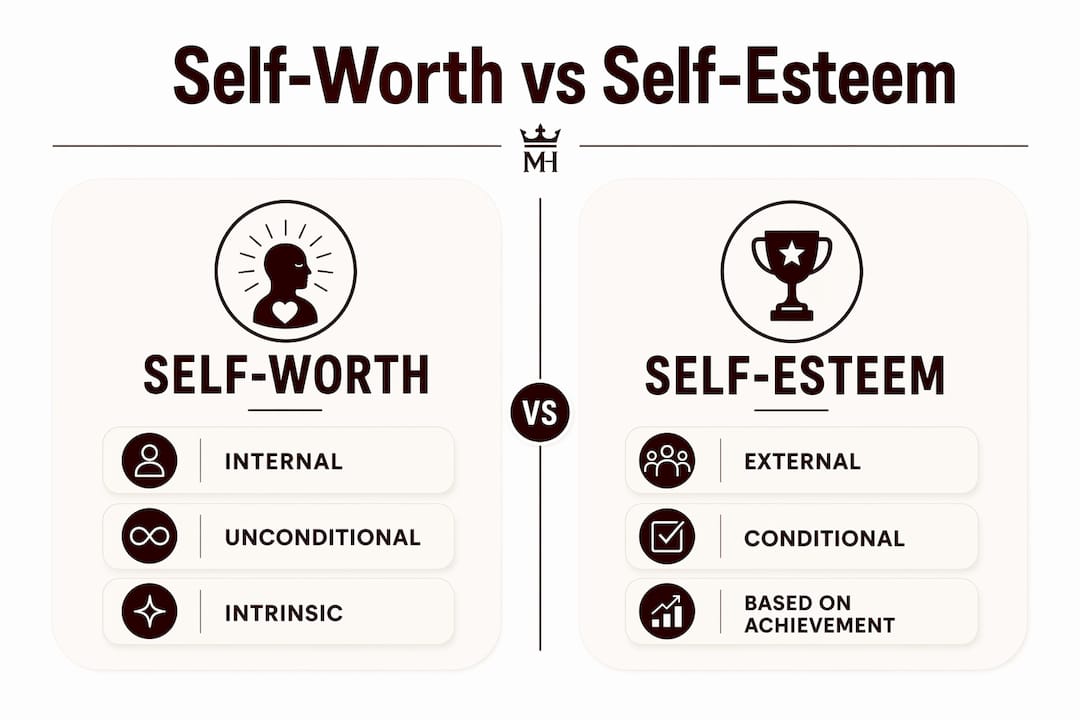
| Dimension | Self-Worth | Self-Esteem |
|---|---|---|
| Source of value | Internal, unconditional | External, performance-based |
| Stability | Consistent across outcomes | Fluctuates with results |
| Common trap | Isolation, not asking for help | Overachievement, perfectionism |
| How it is measured | Behavior alignment with values | Comparison to others or past performance |
Mayo Clinic guidance points directly at language as a lever: absolutist words like “should” and “must” lock you into performance-based self-evaluation. Swapping them for “I choose” or “I want” reduces that pressure immediately.
Evidence-based daily exercises to grow durable self-worth
Durable self-worth is built through cumulative acts of integrity, not one-off exercises. These practices create the lived evidence that makes internal confidence stick.
Daily practices:
- Keep one micro-promise each morning. Make it small enough that skipping feels like a genuine choice.
- Write five personal strengths and keep the list visible. The NHS recommends writing several positive attributes as a baseline practice for challenging negative internal bias.
- Rewrite one “should” thought per day using Mayo Clinic’s language-reframe method.
- Spend two minutes in a body-scan meditation before a high-pressure moment.
Weekly practices:
- Journal with these prompts: What did I follow through on this week? Where did I act from my values? What would I say to a friend who did what I did?
- Review your strengths list and add one new item.
- Identify one neutral comment you misread as negative. Log it. Negativity bias causes people to code neutral feedback as confirmation of their worst beliefs about themselves.
Pro Tip: Pin your positives list to the inside of your closet door. Pair reading it with putting on a reminder garment each morning. The physical ritual anchors the habit and makes the list harder to skip.
Your 4-week habit plan for building inner confidence
Week one through four is a progression, not a sprint. Each week adds one layer.
| Week | Focus | Daily Action | Tracking Signal |
|---|---|---|---|
| 1 | Micro-promises + positives list | Keep one small promise; read strengths list | Did I follow through? Yes/No |
| 2 | Journaling + small social steps | Write one journal prompt; text one trusted person | Mood note: 1–5 |
| 3 | Mindful reminders + apparel ritual | Morning body scan; wear reminder garment with intention | Noticed any “should” thoughts? |
| 4 | Review + sustainable cadence | Assess what worked; set a weekly rhythm | Promises kept vs. set |
Daily rhythm that works:
- Morning: read your strengths list while putting on your reminder garment. Two minutes.
- Evening: write one sentence about where you acted from your values today.
Plateaus happen around week two. When they do, shrink the promise, not the goal. A micro-promise you actually keep beats an ambitious one you abandon. If the journaling feels forced, drop to one prompt every three days. Consistency over volume.
How intentional style rituals can reinforce inner self-worth
Clothing is not therapy. But it is a powerful behavioral cue when used with intention rather than performance.

The mechanism is simple: a garment paired consistently with a self-respecting action becomes a trigger for that behavior. Neuroscience calls this “enclothed cognition.” The key is that the cue works privately, not for an audience.
Style rituals that support inner work:
- Select one “reminder garment” and wear it only when doing something that aligns with your values: a boundary-setting conversation, a creative project, a workout.
- Look for quality fabric and a comfortable fit. The tactile experience matters. A heavyweight hoodie that feels substantial reinforces the sensation of being grounded.
- Choose pieces with subtle, identity-forward messaging rather than loud branding. The message should read as a personal truth, not a performance.
- Deep, warm tones like chocolate brown and bronze carry a sense of calm authority. Color psychology supports using grounded, rich tones for focus and self-assurance.
The Mrhappinessofficial ethos is built on exactly this: garments designed as identity reminders, not status signals. The difference is who the piece is for. A reminder garment is for you.
How to recognize real progress and when to seek help
Progress in self-worth is behavioral before it is emotional. Watch for these signs:
- Fewer episodes of seeking reassurance from others before making a decision.
- Steadier mood after criticism. Not numb, but not destabilized.
- Clearer boundaries. Saying no without a lengthy internal negotiation.
- Noticing when you act from values rather than fear.
Dr. Mark Travers notes that reassurance-seeking is a learned regulation strategy. When it decreases, that is a measurable sign of internal stability growing.
When to get professional help: If low self-worth is affecting your relationships, work, or daily functioning, a licensed therapist can accelerate this work significantly. In the US, the Psychology Today therapist directory and SAMHSA’s National Helpline (1-800-662-4357) are solid starting points. Cognitive behavioral therapy (CBT) is particularly well-matched to the language-reframe and core-belief work described here.
How to stop seeking external validation
Reassurance-seeking becomes a problem when it replaces internal regulation entirely. The fix is not willpower. It is practice.
Each time you catch yourself seeking reassurance, pause and ask: What do I actually know about this situation? Then act on that answer. Over time, the internal voice gets louder because you keep consulting it. The external one loses authority because you stop feeding it.
Why community corrects isolation
Dr. Adia Gooden identifies isolation as one of the primary drivers of low self-worth. When you withdraw, the internal critic gets the only airtime. Community does not fix self-worth, but it interrupts the loop.
Seek people who normalize struggle without dramatizing it. A single honest conversation with someone who has faced similar doubts can disrupt weeks of internal narrative. That is not dependency. That is calibration.
How to dismantle negative core beliefs
Core beliefs formed in childhood run deep. Aaron Beck’s foundational work in cognitive behavioral therapy showed that these beliefs shape how people interpret nearly every experience. The practice is not to silence them but to challenge them with evidence.
Write the belief down. Then write three specific examples that contradict it. Not affirmations. Evidence. “I am not capable” meets “I completed X, handled Y, and figured out Z on my own.” The brain responds to specifics, not slogans.
Mindfulness practices that build self-worth specifically
Generic meditation helps mood. Targeted mindfulness builds self-worth. The difference is focus.
Try a five-minute “values check-in” meditation: sit quietly, breathe, and ask yourself one question: Did I act like someone who respects themselves today? No judgment. Just observation. Over weeks, this practice trains self-awareness rather than self-criticism.
Body-scan meditation before high-pressure moments reduces the physiological stress response that often triggers reassurance-seeking. Two minutes is enough.
Physical self-care as a foundation for inner confidence
Sleep, movement, and nutrition are not separate from self-worth work. They are the substrate. Physical self-care supports a more stable sense of self over time by regulating mood and energy, which directly affects how you interpret events and treat yourself.
A consistent morning routine, even a ten-minute one, signals to yourself that your time and body matter. That signal compounds.
Staying grounded when criticism or setbacks hit
Setbacks do not erase progress. They test whether the foundation is behavioral or emotional. If self-worth is built on kept promises and values-aligned action, a single bad day does not collapse it.
When criticism lands, separate the feedback from the identity. “That presentation missed the mark” is information. “I am not good enough” is a story. Write the factual version down. Act on the information. Leave the story alone.
Unconditional self-worth includes forgiveness. Not as a performance of grace, but as a practical refusal to let one moment define the whole.
Key Takeaways
Building self-worth from within requires consistent behavioral follow-through, honest self-observation, and a community that normalizes struggle, not just positive thinking.
| Point | Details |
|---|---|
| Keep small promises | Daily follow-through creates lived evidence your nervous system learns to trust. |
| Maintain a visible strengths list | Write at least five positive attributes and keep the list somewhere you see it daily. |
| Rewrite absolutist language | Replace “should” and “must” with “I choose” to reduce performance-based pressure. |
| Seek community intentionally | Supportive relationships interrupt the isolation loop that fuels low self-worth. |
| Use apparel as a private cue | Mrhappinessofficial reminder garments pair identity-forward design with daily behavioral rituals. |
Style and mindset belong together
The conventional wisdom says inner work and outer style are separate lanes. One is serious. One is superficial. That framing is wrong.
What you put on your body every morning is a decision about identity. It is either intentional or it is not. The people who dismiss clothing as shallow are often the same ones who have never used it deliberately. A garment that carries a personal truth, worn consistently during values-aligned action, becomes a behavioral anchor. That is not fashion psychology. That is just how habits form.
The mistake most people make is using style for the audience rather than for themselves. The moment a piece of clothing becomes about how others perceive you, it stops reinforcing self-worth and starts feeding the reassurance loop. The private ritual is the point.
Wear the reminder every day
The inner work is primary. The garment is the anchor.

Mrhappinessofficial builds premium streetwear around one idea: your worth is not labeled, priced, or granted by anyone else. The “Be Unforgettable” Hoodie and the “Mind Over Noise” Joggers are designed as daily identity cues, not status pieces. Heavyweight fabric. Subtle, affirming text. Built to be worn during the moments that matter to you privately.
For a complete ritual outfit, The Happiness Set pairs a hoodie and joggers into one starting point. Apparel is an adjunct to this work. Behavior change and, where needed, therapy are the primary tools. The reminder garment is the cue that keeps you honest between sessions.
Browse the full collection at Mrhappinessofficial and choose the piece that fits your ritual.
Useful sources and further reading
- NHS: Raising low self-esteem — Practical self-help guidance including the five-positives list practice.
- Mayo Clinic: Self-esteem — Clinical guidance on adjusting internal monologue and removing absolutist language.
- Healthline: 8 Healthy Habits to Improve Your Self-Esteem — Behavioral habits including micro-promises and physical self-care.
- Forbes / Dr. Mark Travers: 5 Ways To Build Self-Worth Without Reassurance — Psychologist-backed methods for reducing external validation dependency.
- PositivePsychology.com: What is self-worth? — Worksheets and guided exercises for self-understanding and acceptance.
- TED Ideas: How to cultivate unconditional self-worth — Clinical and therapeutic framing of long-term self-worth practice.
- Annie Wright: Healthy self-worth after tying worth to achievement — Foundational distinction between self-worth and self-esteem.
- Dr. Adia Gooden: Episode archive on community and self-worth — Expert perspective on isolation and community as correctives.
- US mental health resources: SAMHSA National Helpline: 1-800-662-4357 (free, confidential, 24/7). Psychology Today therapist directory: psychologytoday.com/us/therapists.
This article is general information, not professional mental health advice. For concerns about your own well-being, consult a licensed mental health professional or contact SAMHSA’s National Helpline.