
Why Resilience Defines Great People and Leaders
Resilience is defined as the dynamic process of adapting, growing, and sustaining performance through adversity. It is the single quality that separates people who achieve greatness from those who stall at the first sign of difficulty. Research confirms that resilience outperforms IQ as the top predictor of long-term leadership success. Understanding why resilience defines great people starts with recognizing that it is not a personality type you are born with. It is a skill. One you can build, practice, and own.
Why resilience defines great people: the real definition
Most people think resilience means being tough. Unshakable. Never cracking. That definition is wrong, and it holds people back.
Resilience is a dynamic process involving emotional, cognitive, and social factors working together. It is not a fixed trait locked into your DNA. It shifts based on your habits, your relationships, and how you respond to pressure. That shift is the point. Resilience is not about being unmoved by difficulty. It is about moving through difficulty without losing your direction.

The importance of resilience goes beyond bouncing back. Wharton Executive Education identifies resilience as involving preparation, adaptability, and growth under pressure, not just recovery after failure. That distinction matters. Reactive resilience waits for the hit. Proactive resilience builds the foundation before the hit arrives.
Here is what resilience actually looks like in practice:
- Emotional processing: Feeling the weight of a setback without letting it define your next move
- Cognitive flexibility: Reframing a failure as a data point, not a verdict
- Social anchoring: Leaning on trusted people when your own perspective narrows
- Adaptive action: Adjusting your approach without abandoning your goal
Pro Tip: Write down one thing you learned from your last setback. Not what went wrong. What you now know that you did not know before. That single habit starts the resilience cycle.
What are the core characteristics of resilient people?
Resilient people share specific traits. These are not personality quirks. They are practiced behaviors that anyone can develop.
-
Emotional regulation. Resilient people feel their emotions fully. They do not suppress or avoid them. Psychology Today confirms that emotional avoidance weakens resilience, while acceptance strengthens it. Allowing distress to run its course gives you evidence that it is temporary and manageable.
-
Growth mindset. Every setback feeds the next win. Resilient leaders operate on a “learn-grow-learn-grow” flywheel that compounds better judgment over time. They do not just endure hardship. They extract lessons from it and carry those lessons forward.
-
Realistic optimism. This is not blind positivity. Resilient people acknowledge what is hard while holding a clear belief that they can handle it. That balance keeps them grounded without pulling them into despair.
-
Strong social connections. No one builds resilience alone. Seeking mentorship, building honest relationships, and staying connected to people who challenge you all reinforce your capacity to recover and grow.
-
Using emotions as data. Highly resilient individuals treat emotional responses to failure as information, not identity. They notice the feeling, extract what it tells them, and move forward without ruminating.
Pro Tip: After any difficult conversation or failure, ask yourself: “What is this feeling telling me?” That one question shifts you from reaction to reflection.
How does resilience shape long-term success and greatness?
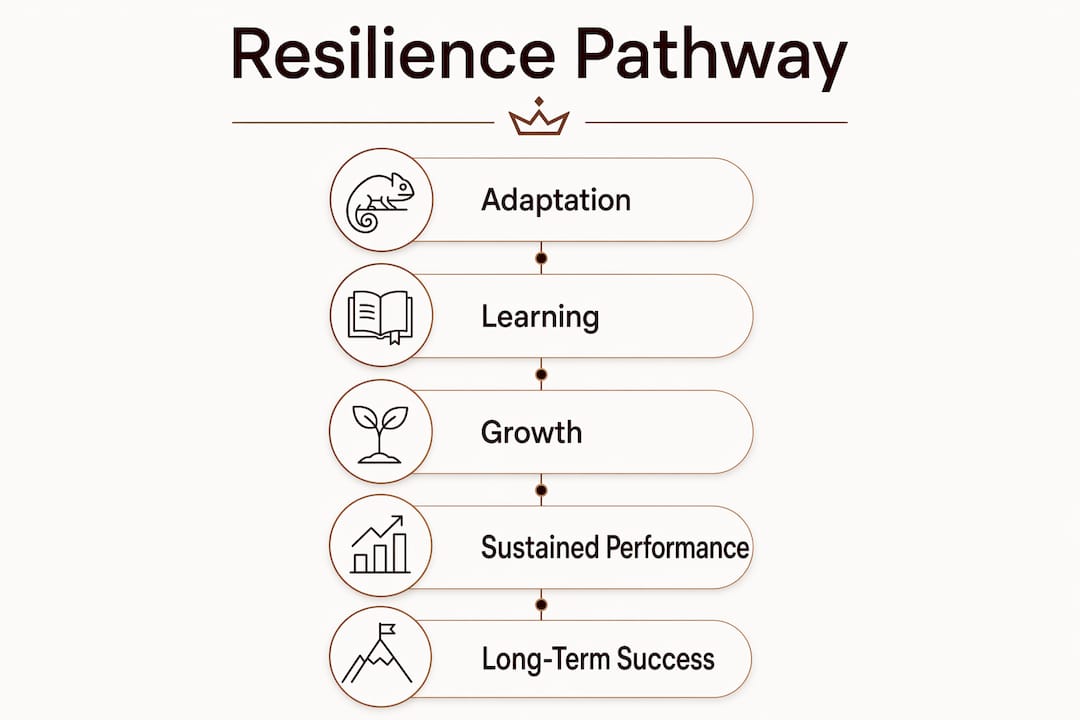
The evidence connecting resilience to success is direct and consistent. Resilient leaders maintain performance and trust during instability more effectively than less resilient peers. That is not a soft claim. It is the measurable difference between leaders who hold teams together in a crisis and those who fragment under pressure.
Early setbacks play a surprising role. Research shows that individuals who face early career setbacks often achieve greater long-term success than those with early wins. The reason is concrete: setbacks force emotional regulation and problem-solving skills that smooth paths never require. People who struggle early build the mental tools that carry them further, longer.
| Resilience factor | Impact on success |
|---|---|
| Emotional regulation | Sustains decision quality under pressure |
| Growth mindset | Converts failures into compounded learning |
| Social support | Accelerates recovery and broadens perspective |
| Proactive preparation | Reduces time lost to reactive crisis management |
“Resilience is not the absence of difficulty. It is the presence of the capacity to grow through it. The leaders who last are not the ones who avoided hardship. They are the ones who let hardship teach them.”
Resilience also supports physical and mental health over time. Research published by Time confirms that resilience acts as medicine for both mental and physical well-being, motivating people to persist through recovery and maintain healthy habits. That sustained health is itself a competitive advantage. You cannot perform at your peak if your body and mind are running on empty.
What common myths about resilience hinder developing it?
Several widespread beliefs about resilience actively prevent people from building it. Recognizing these myths is the first step toward replacing them with accurate understanding.
-
Myth: Resilient people do not feel fear or pain. False. Resilient people feel both. The difference is that they do not let fear or pain make their decisions. Suppressing emotion does not build strength. It delays the processing that actually creates strength.
-
Myth: Resilience is an innate trait you either have or do not. Research from Wharton Executive Education is clear: resilience is a set of skills developed through deliberate practice. Many people fail to build it simply because they believe they cannot.
-
Myth: Staying calm under pressure means you are resilient. Calm is sometimes a sign of resilience. It is also sometimes a sign of emotional shutdown. True resilience involves active engagement with difficulty, not detachment from it.
-
Myth: Resilience means going it alone. The most resilient people are often the most connected. Isolation weakens your capacity to recover. Community accelerates it.
-
Myth: You build resilience by pushing through without stopping. Rest, reflection, and recovery are not signs of weakness. They are part of the resilience process. Ignoring that burns people out rather than building them up.
How can you build and strengthen resilience to achieve greatness?
Building resilience is a practice, not a one-time decision. The benefits of being resilient compound over time when you apply specific habits consistently.
-
Practice emotional acceptance daily. When something goes wrong, name the emotion out loud or in writing. Acceptance, not avoidance, is what strengthens your coping capacity. This is the foundation everything else builds on.
-
Adopt the learn-grow cycle. After every setback, ask two questions: What happened? What do I do differently next time? This is the flywheel that separates resilient people from those who simply repeat the same mistakes with more frustration.
-
Build your support system before you need it. Seek mentors who have navigated what you are facing. Invest in relationships that offer honest feedback, not just comfort. The habits and relationships you build in calm periods are the ones you draw on in hard ones.
-
Seek diverse perspectives. Resilient people actively expose themselves to viewpoints that challenge their own. This prevents tunnel vision during crises and builds the cognitive flexibility that good decisions require.
-
Wear your mindset. Identity shapes behavior. The way you dress, the words you repeat, and the environment you create all signal to your brain who you are. Pair your mindset practices with physical reminders that reinforce your commitment to growth.
Pro Tip: Set a weekly 10-minute review. Write one setback from the week, one lesson extracted, and one adjustment for next week. That simple ritual builds the learn-grow flywheel into your routine.
Key Takeaways
Resilience is the defining skill of great people because it converts adversity into compounded growth, sustained performance, and lasting success.
| Point | Details |
|---|---|
| Resilience is a skill, not a trait | Anyone can build resilience through deliberate practice and mindset shifts. |
| Emotional acceptance is the foundation | Accepting emotions rather than avoiding them strengthens your ability to cope and recover. |
| Setbacks accelerate growth | Early career difficulties build the emotional regulation and problem-solving skills that drive long-term success. |
| The learn-grow flywheel compounds results | Extracting lessons from every failure creates better judgment that accumulates over time. |
| Community multiplies resilience | Strong relationships and mentorship accelerate recovery and broaden perspective during adversity. |
Resilience is the one thing I keep coming back to
I have watched talented people stall out. Not because they lacked skill or intelligence. Because the first real hit knocked something loose in them that they never put back together. And I have watched people with far less natural ability outlast, outperform, and outgrow everyone around them. The difference was always the same thing. How they handled the hard part.
What I have come to believe is that resilience is not a character trait reserved for exceptional people. It is a practice available to anyone willing to do the uncomfortable work of sitting with failure long enough to learn from it. The people who achieve real greatness are not the ones who avoided pain. They are the ones who got curious about it.
The most underrated resilience habit I know is this: treat your emotional response to failure as a signal, not a sentence. That shift alone changes everything. It moves you from victim of circumstance to student of experience. And students who keep showing up eventually become the ones worth learning from.
— Kofi
What you wear is a reminder of who you are
Resilience is not just a mindset. It is an identity. And identity shows up in how you carry yourself every single day.
Mrhappinessofficial builds apparel for people who have decided that their worth is not up for debate. The Signature Zip Hoodie and the “Be Unforgettable” Hoodie are not just clothing. They are daily reminders to protect your mindset, stay confident, and keep moving. Every piece in the signature collection is built for people who understand that greatness is earned through consistency, not circumstance. Wear the reminder.
FAQ
What is resilience and why does it matter for success?
Resilience is a dynamic, learnable process of adapting and growing through adversity. Research confirms it is the top predictor of long-term leadership success, surpassing IQ and academic background.
Can resilience be learned, or is it something you are born with?
Resilience is a set of skills built through deliberate practice, not an innate personality trait. Wharton Executive Education confirms that anyone can develop it through consistent habits and mindset shifts.
How does emotional acceptance build resilience?
Accepting emotions rather than avoiding them gives people evidence that distress is temporary and manageable. Psychology Today research shows that emotional avoidance weakens resilience, while acceptance strengthens coping capacity.
Why do early setbacks often lead to greater long-term success?
Early setbacks force people to develop emotional regulation and problem-solving skills that smooth paths never require. Research shows a positive correlation between early career difficulties and superior long-term professional outcomes.
How does resilience affect physical and mental health?
Resilience supports sustained mental and physical well-being by motivating people to persist through recovery and maintain healthy habits. Time magazine research describes resilience as functioning like medicine for overall health.