
Why Inner Confidence Outweighs Labels: Build Real Self-Worth
Inner confidence is defined as the ability to act and value yourself independently of external labels and societal classifications. Most people spend years chasing validation through titles, status, and the opinions of others. That chase is exhausting, and it never ends. Why inner confidence outweighs labels comes down to one fact: labels are borrowed identities, while inner confidence is your own. Mrhappinessofficial was built on exactly this truth. Special isn’t priced or labeled by the world. It’s who you are.
Why inner confidence outweighs labels: the core case
Labels are cognitive shortcuts. They compress complex human behavior into a single word and then treat that word as permanent. Labeling theory, a concept rooted in sociology and psychology, explains how these shortcuts stop being descriptions and start becoming instructions. Once you accept a label, your brain filters reality through it. You notice evidence that confirms the label and ignore everything that contradicts it. That’s confirmation bias working against you.
The real problem is what labels do to your sense of possibility. Labels are often interpreted as verdicts limiting life possibilities rather than descriptive states of behavior. A verdict feels final. A description is just a snapshot. When you treat a label as a verdict, you stop trying to write a different story.

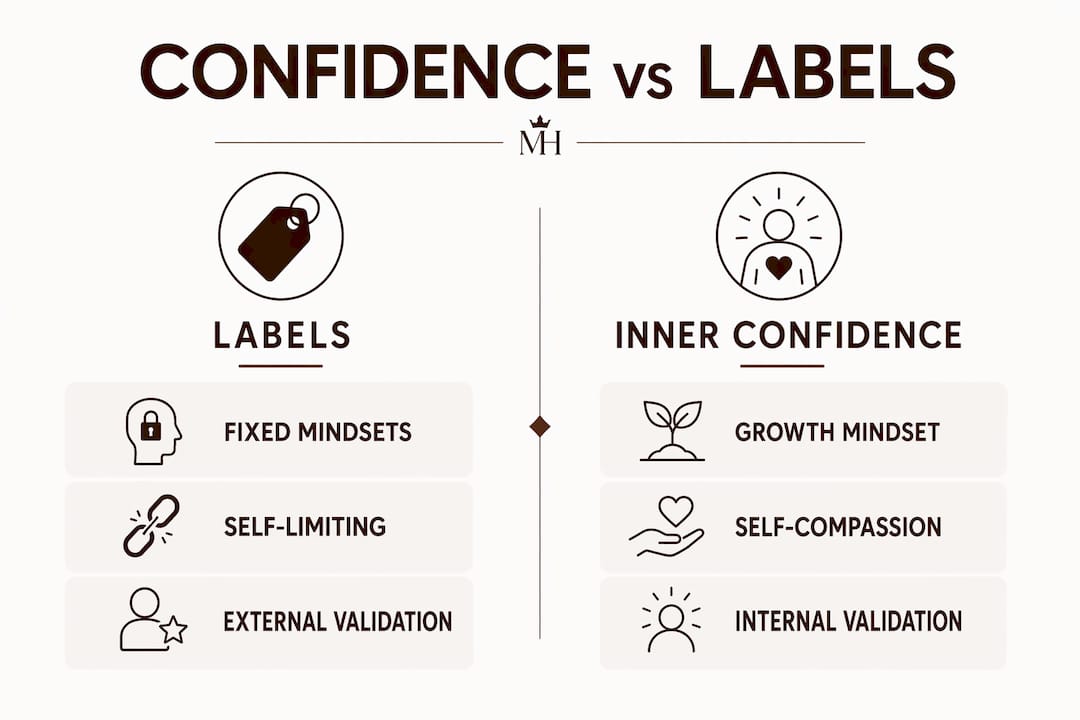
Inner confidence operates on a completely different logic. It doesn’t require external proof. Authentic internal confidence is defined as acting amid uncertainty, accepting failure without identity collapse, unlike labels that require 100% validation. That distinction matters. A label collapses the moment reality doesn’t match it. Inner confidence holds steady because it was never tied to a specific outcome.
How labels create fixed mindsets that limit personal growth
Labels don’t just shape how others see you. They reshape how you see yourself, and that shift happens fast. Research on labeling theory shows that people minimize achievements that conflict with their labels and may cease effort altogether in those areas. That’s not laziness. That’s the label doing its job.
The mechanism behind this is the self-fulfilling prophecy. Labels create cognitive shortcuts that trigger confirmation bias, producing self-fulfilling prophecies where labels dictate behavior rather than reality. You call yourself “bad with money,” so you stop tracking your spending. You call yourself “not athletic,” so you skip the gym. The label predicts the outcome, and the outcome confirms the label.
Labels also carry what psychologists call a semantic payload. The word “lazy,” for example, implies permanence and blame, making rest a symptom rather than recovery. That single word rewires how you interpret your own behavior. Rest becomes evidence of a character flaw instead of a biological need.
Here’s where the damage compounds:
- Labels reduce the range of identities you believe are available to you.
- They make growth feel like betrayal of who you “really are.”
- They create emotional resistance to new experiences that don’t fit the label.
- They make failure feel like proof rather than data.
Pro Tip: Write down three labels you currently carry. For each one, ask: “Is this a permanent truth about me, or a description of something I did in a specific context?” The answer almost always reveals the label is situational, not essential.
Why self-compassion builds more stable confidence than labels
Contingent self-worth is the term psychologists use when your self-image depends on external conditions being met. A label is one of those conditions. When the label holds, you feel okay. When reality contradicts it, your sense of self takes a hit. Contingent self-worth tied to external labels makes self-image fragile, increasing stress reactivity compared to internal validation. That stress isn’t just emotional. It’s physical. Cortisol spikes. Recovery slows. Decision-making suffers.
Inner confidence built on self-compassion doesn’t work that way. Self-compassion is the practice of treating yourself with the same care you’d offer a close friend after a setback. Self-compassion provides the secure foundation to fail without self-image defense, acting as the key to authentic confidence. That security is what makes inner confidence stable. You can fail, learn, and move forward without needing to protect a label.
Most people mistake self-compassion for weakness. It’s the opposite. Self-compassion is the foundation of true confidence, enabling learning and growth without fear of self-judgment. Weakness collapses under pressure. Self-compassion absorbs it.
Building this kind of confidence requires a shift in how you define success:
- Redefine winning. Shift success from constant victory to consistent direction. Progress beats perfection every time.
- Accept uncertainty as normal. Confidence isn’t feeling certain before you act. Redefining confidence as “acting while uncertainty is present” unlocks growth immediately.
- Separate outcomes from identity. A bad result tells you what didn’t work. It says nothing permanent about who you are.
- Practice self-care as a biological tool. Physical self-care modulates cortisol and sustains the emotional resilience required for strong inner confidence.
Pro Tip: After any setback, write one sentence about what you learned and one sentence about what you did well. This practice rewires your brain to process failure as information rather than identity.
How to reframe your relationship with labels
Labels are coping mechanisms, not essence. You can change your narrative anytime without external permission. That’s the most liberating fact in personal development, and most people never hear it stated that plainly.
The first step is recognizing the difference between a label and a behavior description. A label says “I am X.” A behavior description says “I did X in that situation.” One is a verdict. The other is data. Replacing static labels with functional, behavior-based definitions expands your potential rather than constraining it.
Language shifts are the most direct tool for this. The “Label Gap” explains the disconnect between internal experience and external label expectations. Real confidence arises from discarding unreachable labels and accepting normal human doubts. When you close that gap, you stop performing an identity and start living one.
| Traditional label | Functional reframe |
|---|---|
| “I am anxious” | “I feel anxious in high-pressure situations” |
| “I am lazy” | “I struggle to start tasks without clear structure” |
| “I am bad at relationships” | “I’m still learning how to communicate my needs” |
| “I am not creative” | “I haven’t found the creative format that works for me yet” |
| “I am a failure” | “That specific attempt didn’t produce the result I wanted” |
Three strategies accelerate this reframe:
- Awareness. Notice when you use “I am” to describe a behavior. Catch the label in real time.
- Questioning. Ask whether the label describes every situation or just specific ones. Labels rarely hold up under scrutiny.
- Environment. Spend time with people who see your potential, not your past. A supportive environment actively dismantles limiting labels.
Practical steps to build lasting inner confidence
Inner strength over societal labels isn’t a mindset shift you make once. It’s a practice you return to daily. The good news is that the practices are simple, and they compound over time.
Start with self-knowledge. Journaling, personality assessments approached with curiosity, and noticing the difference between your authentic self and your performed self all build the internal map you need. When you know yourself clearly, labels have less surface to stick to.
Physical self-care belongs in this conversation. Sleep, movement, and nutrition directly regulate cortisol. Lower cortisol means clearer thinking and steadier emotional responses. That’s not a wellness cliché. It’s biology working in your favor.
Here’s a practical daily framework:
- Morning check-in. Spend two minutes identifying one thing you value about yourself that has nothing to do with productivity or achievement.
- Label audit. Once a week, review the labels you’ve been carrying. Ask which ones still serve you and which ones are just old stories.
- Criticism filter. When criticism arrives, separate the feedback from the verdict. Useful feedback describes behavior. Harmful labels describe character.
- Relationship review. Identify one relationship that reinforces your authentic self-worth and invest in it deliberately.
- Celebrate direction, not destination. Acknowledge progress in the direction you’re moving, not just outcomes you’ve reached.
The power of self-belief is not a fixed state. It’s a trust relationship with yourself that exists independently of consistent success and doesn’t require performance to be maintained. That trust is built through small, repeated acts of self-honesty and self-care.
Key takeaways
Inner confidence outweighs labels because it is built on self-compassion and internal validation, making it stable under pressure where label-based self-worth collapses.
| Point | Details |
|---|---|
| Labels create fixed mindsets | Labeling theory shows people stop trying in areas where they’ve accepted a limiting label. |
| Contingent self-worth is fragile | Self-image tied to external labels increases stress reactivity and emotional instability. |
| Self-compassion is the foundation | Treating yourself with care after failure builds confidence that doesn’t depend on outcomes. |
| Language shifts change behavior | Replacing “I am X” with “I did X in that context” converts verdicts into useful data. |
| Inner confidence is a daily practice | Journaling, self-care, and relationship investment build self-worth that operates independently of labels. |
What I’ve learned about shedding labels
For a long time, I carried labels I never chose. “Too much.” “Not serious enough.” “Doesn’t fit.” I wore them like they were facts. The turning point wasn’t a single moment of clarity. It was the slow realization that those labels described other people’s comfort levels, not my actual capacity.
What changed everything was understanding that confidence isn’t a fixed state. It’s a muscle you use by acting despite uncertainty. The days I felt least confident were often the days I grew the most, because I moved anyway. That’s the part no one tells you. Growth doesn’t wait for you to feel ready.
The labels don’t disappear overnight. But they lose their grip when you stop feeding them with belief. Embracing self-worth means accepting that you are always more than the last thing someone called you. That’s not arrogance. That’s accuracy. Mrhappinessofficial puts it simply: special isn’t given by the world. It’s who you are. I believe that. And the more you practice living from that place, the less any label can touch you.
— Kofi
Wear what you believe
Mrhappinessofficial builds apparel for people who are done performing identities they didn’t choose. Every piece is a reminder that your worth isn’t up for debate.

The Signature Zip Hoodie is premium, heavyweight, and built to last. It’s not a fashion statement. It’s a mindset statement. The “Mindset Over Opinion” Pants carry that same energy. Wear them when you need a reminder that no label defines your direction. Browse the full Mrhappinessofficial collection and find the piece that fits where you’re going, not where you’ve been.
FAQ
What is inner confidence and how does it differ from self-esteem?
Inner confidence is the ability to act and value yourself independently of external outcomes or labels. Self-esteem often fluctuates with performance, while inner confidence remains stable because it’s rooted in self-compassion rather than results.
Can labels ever be positive or useful?
Labels can provide temporary structure or community belonging, but even positive labels create fragility when your self-worth depends on maintaining them. Functional behavior descriptions serve the same purpose without locking your identity in place.
How do I stop internalizing negative labels from others?
Separate the label from the behavior it describes. Ask whether the label reflects a permanent truth or a specific situation. Replacing static labels with behavior-based descriptions reduces their power over your self-image.
How long does it take to build genuine inner confidence?
Inner confidence builds through repeated small actions taken despite uncertainty, not through a single breakthrough. Daily practices like journaling, self-care, and honest self-reflection compound over weeks and months into lasting self-worth.
Why does self-compassion matter for confidence?
Self-compassion removes the threat of failure from your identity. When failure doesn’t collapse your sense of self, you take more risks, learn faster, and build the kind of confidence that external labels can never provide.