
Why Community Matters for Confidence and Self-Worth
Community is defined as a group of people who share belonging, purpose, and mutual support. That shared structure is the foundation of personal confidence. Research confirms that active participation in community increases self-esteem by giving people concrete evidence of their own competence. This is not a soft claim. The connection between belonging and confidence is one of the most consistent findings in social psychology. Whether you are 18 or 45, the communities you engage with shape how you see yourself, how you handle setbacks, and how much you believe in your own ability to grow.
Why community matters for confidence: the psychology behind it
Belonging is not a luxury. It is a psychological need, and when it is met, self-esteem rises. Participation intensity precedes self-esteem growth and reduces loneliness. That sequence matters. You do not wait to feel confident before joining. You join, you participate, and confidence follows.
The mechanism works through identity. When you take an active role in a group, your sense of self shifts from “outsider looking in” to “person who contributes here.” That shift is not cosmetic. It rewires how you interpret your own actions. A person who organizes a community event does not just feel useful in that moment. They carry that evidence of competence into every other area of life.
Active roles that build self-esteem include:
- Mentoring a newer member of a group or team
- Volunteering for a visible responsibility within the community
- Organizing events, discussions, or shared projects
- Showing up consistently, which builds a reputation others reflect back to you
Pro Tip: You do not need a title or a platform to contribute. Answering one question in a group chat or showing up reliably to a weekly meetup counts as active participation. Start there.
The importance of community for self-esteem is not about the size of your role. It is about the consistency of your presence and the realness of your contribution.
How does belongingness predict confidence across different life contexts?
Perceived belongingness is the single strongest predictor of self-esteem during periods of stress and transition. Belongingness correlates strongest with self-esteem during transitional phases, which is exactly the territory most people aged 18–45 are navigating. New jobs, new cities, new relationships, and new identities all create stress. Community absorbs that stress.

The role of friendship in self-confidence is especially clear during these transitions. A close friend who knows your history and believes in your potential provides a mirror that reflects a more accurate and generous version of yourself than the one anxiety creates. That reflection builds confidence in a way that no solo achievement can fully replicate.
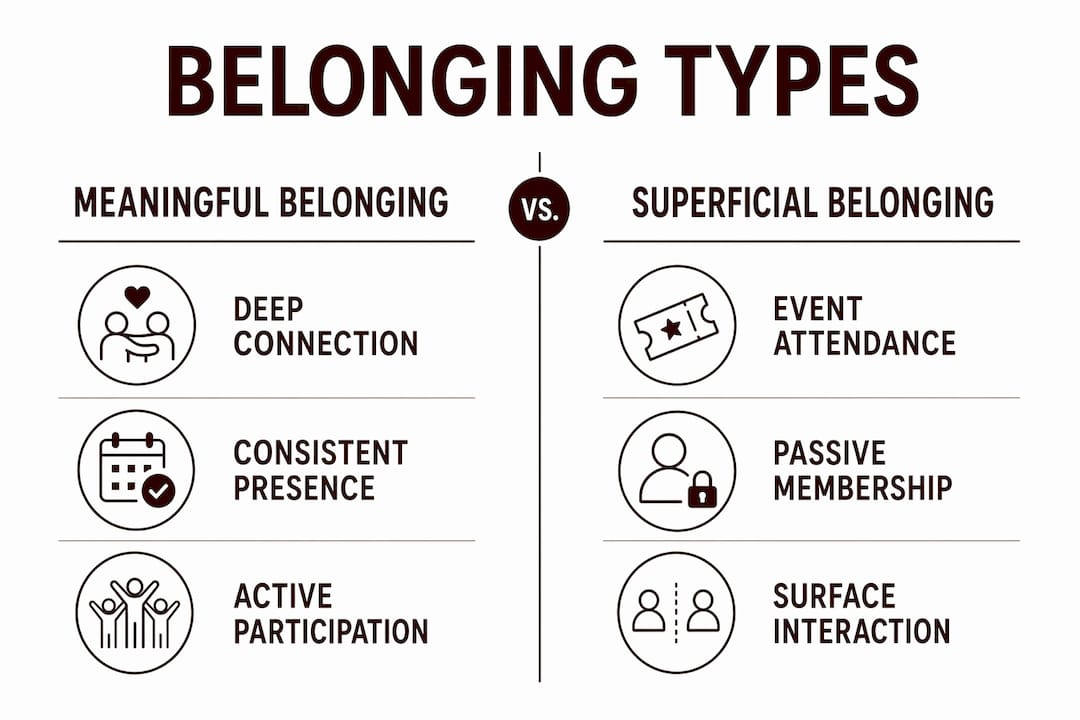
The difference between superficial and meaningful belonging is significant. Showing up to events without real connection does not produce the same confidence gains as genuine engagement. The table below illustrates how different community contexts affect confidence outcomes.
| Community context | Type of belonging | Confidence impact |
|---|---|---|
| Close friendships | Deep, reciprocal | Strongest self-esteem protection |
| Family networks | Foundational, unconditional | Baseline security and identity |
| School or work groups | Role-based, structured | Competence validation |
| Interest-based communities | Shared values, chosen | Purpose and self-expression |
| Casual social groups | Surface-level, low commitment | Minimal lasting confidence gain |
Quality over quantity in community engagement correlates with stronger mental health protection. Having one or two deeply engaging memberships outperforms a dozen shallow ones. That finding should change how you spend your social energy.
Does community boost self-worth through online spaces too?
Online communities build confidence. The mechanism is different from in-person groups, but the outcome is real. Psychological identification with online peer groups boosts confidence in managing challenges more than mere membership does. Joining a group is not enough. Identifying with it, seeing yourself as part of it, is what produces the confidence benefit.
Online spaces offer something offline groups often cannot: low pressure. For people with social anxiety or those rebuilding confidence after a difficult period, the ability to observe before speaking is a genuine advantage. Online communities function as social gyms, where gradual engagement builds interaction tolerance without the stakes of face-to-face contact.
A practical progression for using online communities to build confidence:
- Observe first. Spend one to two weeks reading posts and understanding the group’s tone before contributing.
- Comment on existing posts. A short, genuine response to someone else’s content is a low-risk first step.
- Start a private conversation. Direct messages with one person reduce the pressure of public interaction.
- Post your own content. Share a question, an experience, or a resource that the group would find useful.
- Take on a visible role. Volunteer to moderate a thread, host a discussion, or welcome new members.
Pro Tip: Treat your online community like a gym membership. Showing up three times a week for six months beats one intense session followed by months of absence. Consistency builds the confidence, not the single big moment.
The benefits of support networks online are real, but they work best when paired with genuine identification. Pick communities that reflect who you are or who you want to become, not just communities that are convenient.
What is collective efficacy, and why does it build lasting confidence?
Collective efficacy is defined as a group’s shared belief in its own capability to succeed. Collective efficacy reduces anxiety and sustains confidence even when individual motivation drops. That is the key distinction between group-based confidence and solo willpower. When your personal drive fades, the group’s momentum carries you.
This is why confidence built inside a strong community outlasts confidence built in isolation. A person who trains alone relies entirely on their own belief. A person who trains with a group draws on the group’s evidence of success every time they show up. The group’s track record becomes part of their own.
Psychological safety is the environment that makes collective efficacy possible. Environments that allow vulnerability without judgment create the conditions for genuine confidence. Fragile confidence, the kind built on performance and pretense, collapses under pressure. Authentic confidence, built through honest disclosure in safe spaces, holds.
“Confidence built on psychological safety is more lasting than that based on performance or pretense. True confidence grows where people can be honest about their struggles without fear of losing their place in the group.”
Showing vulnerability attracts supportive connections and strengthens confidence. Psychologists call this the “beautiful mess effect.” When you show an imperfect, honest version of yourself, people connect with it. That connection makes you feel valued. Feeling valued is a core human need, and meeting it inside a community is one of the fastest paths to genuine self-worth.
Key Takeaways
Community builds confidence through active participation, genuine belonging, and shared belief in group capability, not through passive membership or surface-level connection.
| Point | Details |
|---|---|
| Active participation drives confidence | Contributing to a community produces concrete evidence of competence that raises self-esteem. |
| Belonging quality beats quantity | One or two deeply engaging communities protect mental health more than many shallow memberships. |
| Online identification matters | Psychological identification with an online group, not just membership, is what builds confidence. |
| Collective efficacy sustains growth | A group’s shared belief in its capability carries members through periods of low individual motivation. |
| Vulnerability accelerates connection | Small honest disclosures attract support and make people feel valued, which deepens self-worth. |
What I have learned about community and confidence the hard way
I spent a long time thinking confidence was something you built alone. You worked harder, achieved more, and eventually felt secure enough to show up. That model is backwards. Every time I waited to feel ready before engaging with a group, I stayed stuck. The confidence never arrived on its own.
What actually moved the needle was small acts of contribution before I felt qualified. Answering a question in a forum when I was not sure I had the right answer. Showing up to a group consistently even when I did not feel like it. Those small moves created feedback loops. People responded. I felt useful. Useful became capable. Capable became confident.
The other thing I learned is that not all communities are equal. I wasted years in groups that felt busy but hollow. The shift happened when I stopped chasing volume and started investing in one or two spaces where people actually knew me. That depth changed everything. The role of friendship in self-confidence is not about having many friends. It is about having people who see you clearly and still show up.
If you are building confidence right now, find one community where you can contribute something real. Start small. Stay consistent. The confidence is a byproduct of the showing up, not a prerequisite for it.
— Kofi
Wear what you believe in, every single day
Confidence is not just a mindset. It is a daily practice. Mrhappinessofficial builds apparel for people who have decided to stop waiting for the world to validate them. Every piece is a reminder. Special is not something you earn from others. It is who you are.

The signature collection carries that message into every outfit. From the “Be Unforgettable” Hoodie to the statement pieces built for people who move with intention, Mrhappinessofficial makes apparel that speaks before you do. Wear the reminder. Show up like you mean it.
FAQ
Why does community matter for confidence?
Community provides belonging, validation, and evidence of competence through active participation. These three elements are the core drivers of self-esteem growth, according to social psychology research.
How does active participation build self-esteem?
Active contribution such as mentoring, organizing, or volunteering shifts your identity from passive observer to valued contributor. That identity shift produces lasting confidence gains.
Does online community boost self-worth as much as offline groups?
Online communities build real confidence when members psychologically identify with the group, not just join it. Gradual engagement in online spaces is especially effective for people rebuilding social confidence.
How many communities should you belong to for the best confidence benefits?
One to two deeply engaging memberships produce stronger confidence and mental health benefits than many superficial ones. Depth of connection matters more than the number of groups.
What is the fastest way to build confidence through community?
Show vulnerability before you feel ready. Small honest disclosures attract supportive connections and create the feeling of being valued, which accelerates genuine confidence growth.