
Inner Strength in Practice: Build Confidence That Lasts
What inner strength in practice actually means
Inner strength is a reservoir of psychological and emotional resources — resilience, confidence, self-compassion, determination — that you actively build over time. It is not a fixed trait you either have or lack. Approximately 66% of inner strength is developed through deliberate practice, while about 33% is inherited.
The Theory of Inner Strength clinically demonstrates that cultivating these resources improves quality of life and self-management under adversity. This is not motivational language. It is documented in peer-reviewed research.
The core components of inner strength include:
- Resilience: recovering and adapting when circumstances shift
- Confidence: a stable belief in your own capacity to act
- Self-compassion: treating yourself with the same fairness you’d extend to someone you respect
- Emotional intelligence: reading and regulating your internal states
- Grit: staying committed when the path gets difficult
“Inner strengths include capabilities like mindfulness and resilience, positive emotions like gratitude and self-compassion, attitudes like openness and confidence, and virtues like courage and wisdom. This is the good stuff we want to have inside ourselves.” — Dr. Rick Hanson, psychologist and author of Resilient
Table of Contents
- Proven methods to cultivate inner strength
- How inner strength lives in your body
- Common misconceptions that limit your growth
- How inner strength shapes confidence and self-worth
- Identity expression starts from the inside
- Real-life examples of inner strength in practice
- Daily habits that sustain inner strength
- Wear the reminder: Mrhappinessofficial
- Key Takeaways
Proven methods to cultivate inner strength
Inner strength grows through daily micro-moments, not only during major crises. The HEAL framework, developed by Dr. Rick Hanson, gives that process a clear structure:
- Have a positive experience — notice or deliberately create a moment of confidence, calm, or gratitude.
- Enrich it — stay with that feeling. Let it expand in your body and mind.
- Absorb it — consciously take it in, as if it is soaking into you.
- Link it — hold the positive feeling alongside a related challenge, letting the strength begin to associate with that difficulty.
The critical step most people skip is absorption. Focusing on a positive experience for 12–30 seconds is what creates lasting neurological change. Without that deliberate pause, the moment passes without encoding.
Pro Tip: Set a phone reminder once a day that simply reads “12 seconds.” When it fires, find one genuine positive feeling and hold it. That single habit, repeated consistently, rewires how your brain stores experience.
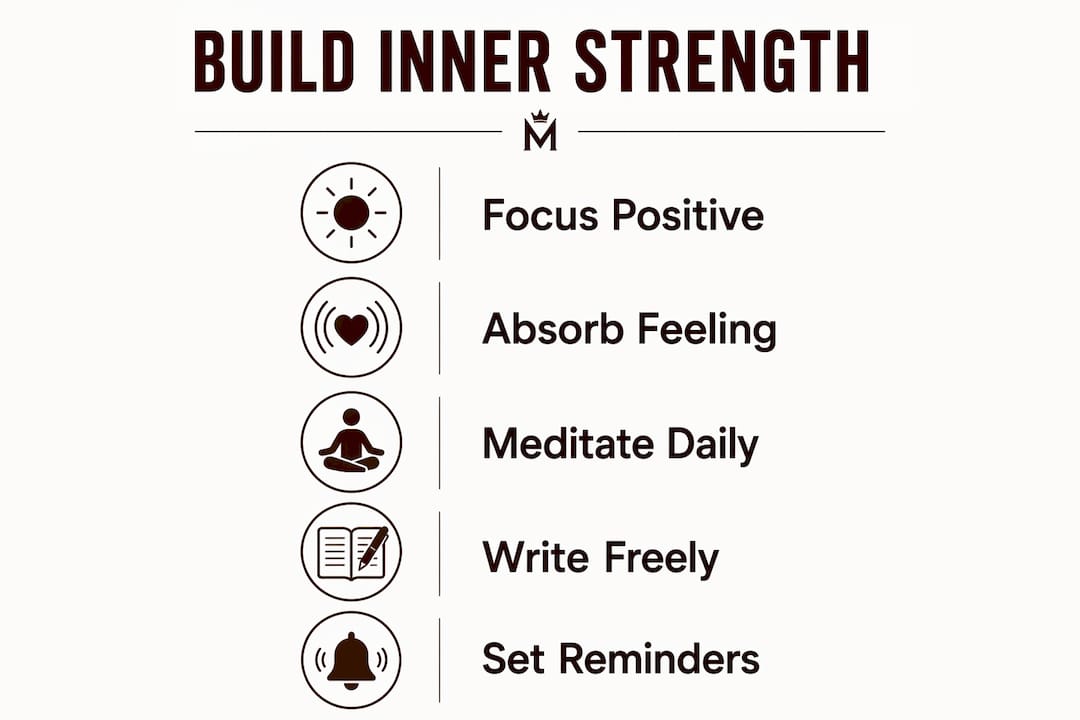
Meditation and story-editing — writing freely about a difficult personal experience without editing or self-censorship — are two additional science-backed practices that build emotional regulation and reframe how you interpret your own story.
How inner strength lives in your body
Psychological strength is not purely mental. You feel it, or you don’t feel it, physically. Posture, breath, and muscle tension all carry information about your internal state — and they can be used to shift it.
are practical tools for accessing inner strength on demand:
- Breath: slow, deliberate exhales activate the parasympathetic nervous system, signaling safety and steadiness
- Posture: an upright, open stance physically primes a confident internal state
- Fist clenching: squeezing your right fist while recalling a moment of grit creates a somatic trigger you can activate under pressure
- Body scan: checking where you hold tension and consciously releasing it clears the physical noise that blocks clear thinking
“What does it feel like when you have grit? You know that inner strength when you know you could never be stuck because you always find the way forward. How do you breathe when you have grit? How do you move?” — Melli O’Brien, meditation teacher
The body is not a passenger. It is part of the system.
Common misconceptions that limit your growth
Most people carry at least one belief about inner strength that quietly works against them. Here are the ones worth dropping:
- “You either have it or you don’t.” False. Approximately 33% of strengths are innate; 66% are developed through intentional practice.
- “You build it during hard times.” Crises can accelerate growth, but waiting for a crisis is not a strategy. Daily micro-moments are the actual building blocks.
- “Noticing good things is enough.” Passive recognition does not deepen inner strength. Active absorption is what converts experience into a lasting trait.
- “Inner strength means not feeling fear or doubt.” Strength is not the absence of those feelings. It is the capacity to act clearly while they are present.
How inner strength shapes confidence and self-worth
Confidence built on external validation is fragile. It depends on approval, performance, and outcomes — all of which shift. Inner strength produces a different kind of confidence: one grounded in your own demonstrated capacity to handle difficulty.
Self-worth follows the same logic. When you have practiced returning to steadiness after setbacks, your sense of value stops depending on what others assign to you. That shift is not philosophical. It is the direct result of repeatedly encoding experiences of competence, resilience, and self-compassion through practices like HEAL.
Identity expression starts from the inside
How you present yourself to the world is a statement about what you believe about yourself. People who have done the work of building inner strength tend to make bolder, more deliberate choices — in how they speak, how they carry themselves, and what they wear.
Identity expression is not performance. It is alignment. When your internal sense of self is solid, your external choices stop being about seeking approval and start being about declaration. That is the difference between dressing to impress and dressing to remind yourself who you are.
Real-life examples of inner strength in practice
Inner strength shows up in ordinary moments, not just extraordinary ones.

A person who pauses before reacting to criticism, finds the steadiness to respond rather than deflect, and moves on without carrying the weight of it — that is resilience in practice. Someone who sets a small daily commitment, keeps it for thirty days, and feels their self-trust grow as a result — that is grit compounding. A person who, after a professional setback, writes honestly about what happened and what it means, then returns to work with clarity — that is story-editing doing its job.
None of these require a crisis. All of them require intention.
Daily habits that sustain inner strength
Consistency matters more than intensity. A few practices, done regularly, build more lasting strength than occasional effort:
- Morning grounding: two minutes of deliberate breathing before checking your phone sets the tone for the day
- Evening reflection: identify one moment where you acted from strength, however small
- Micro-commitments: make one small decision each day and follow through, building the link between intention and action
- Reframe one narrative: when a negative story about yourself surfaces, write a single sentence that offers a more accurate, less punishing interpretation
These are not complicated. They are consistent. That is the point.
Wear the reminder: Mrhappinessofficial

Inner strength needs a daily anchor. Mrhappinessofficial builds that anchor into the clothes themselves.
The brand’s premium streetwear — including the “Mindset Over Opinion” Pants, the “Mind Over Noise” Joggers, and the full Happiness Set — is designed around one idea: special isn’t labeled or priced by the world. It’s who you are.
Every piece is a physical reminder of that. Not a logo to chase. Not a status signal. A declaration. Bold design, heavyweight quality, and a message built into the identity of the garment itself.
Browse the full signature collection and wear the reminder every day.
Key Takeaways
Inner strength in practice means actively encoding resilience, confidence, and self-compassion through daily habits — not waiting for adversity to build them.
| Point | Details |
|---|---|
| Strength is mostly built, not born | Approximately 66% of inner strength develops through deliberate practice, while about 33% is innate. |
| Absorption is the critical step | Holding a positive experience for 12–30 seconds creates lasting neurological change. |
| The body is part of the system | Somatic anchors like breath control and fist clenching make inner strength physically accessible. |
| Daily micro-habits compound | Small, consistent practices build more lasting resilience than waiting for a major crisis. |
| Mrhappinessofficial | Premium streetwear designed as a daily reminder of self-worth, confidence, and identity. |