
What Is Emotional Resilience Explained for Growth
Emotional resilience is defined as the ability to adapt to stress, recover from adversity, and maintain emotional balance without shutting down. The American Psychological Association recognizes it not as a fixed personality trait but as a developable skill anyone can strengthen over time. That distinction matters. You are not born resilient or not resilient. You build it. Neuroplasticity, the brain’s ability to rewire itself through repeated experience, is the biological engine behind that process. Understanding what is emotional resilience explained means understanding that your brain can change, and that change starts with consistent, intentional practice.
What does emotional resilience look like in daily life?
Emotional resilience is not the absence of hard feelings. It is the ability to feel them without losing your footing. A person with strong resilience does not avoid grief, frustration, or fear. They move through those states without getting stuck.
Recognizable signs of high emotional resilience include:
- Staying calm enough to think clearly during conflict or pressure
- Recovering from setbacks within hours or days rather than weeks
- Naming what you feel instead of reacting from it
- Setting limits on situations or relationships that drain you
- Returning to baseline mood after a difficult event without needing to suppress the experience
Contrast that with a low-resilience response: snapping under pressure, replaying failures for days, or numbing out with distraction. Neither response is a character flaw. One is a trained skill. The other is an untrained default.
Emotional labeling, the practice of naming your emotional state precisely, is one of the most underrated tools in understanding emotional resilience. Saying “I feel embarrassed” rather than “I feel bad” activates the prefrontal cortex and reduces the emotional charge of the moment. It is a small act with a measurable effect on how your brain processes stress.

Pro Tip: Set a phone reminder twice a day to pause and name exactly what you are feeling. Use specific words: frustrated, disappointed, anxious, proud. Precision matters more than frequency.
What happens in the brain when building emotional resilience?
The stress response is biological, not a character flaw. When you face a threat, real or perceived, your amygdala fires an alarm. That alarm floods your body with cortisol and adrenaline. Your thinking slows. Your reactions speed up. This is your brain doing its job.
The problem is that the amygdala does not distinguish between a car accident and a difficult email. Resilience keeps the prefrontal cortex active despite that alarm. The prefrontal cortex handles reasoning, decision-making, and emotional regulation. When it stays online during stress, you can respond instead of just react.
“Emotional resilience is the capacity to remain grounded and make clear decisions under stress. It is not the absence of feeling overwhelmed. It is maintaining cognitive control while the amygdala sounds the alarm.”
Practicing emotional labeling 5–10 times daily quiets amygdala activity and strengthens the connection between the emotional brain and the thinking brain. That connection is the neural pathway resilience lives on.
| Brain Region | Role in Stress | Role in Resilience |
|---|---|---|
| Amygdala | Triggers the alarm response | Becomes less reactive with consistent practice |
| Prefrontal cortex | Slows down under acute stress | Stays active in resilient people during pressure |
| Neural pathways | Default to reactive patterns | Rewire through repeated intentional responses |
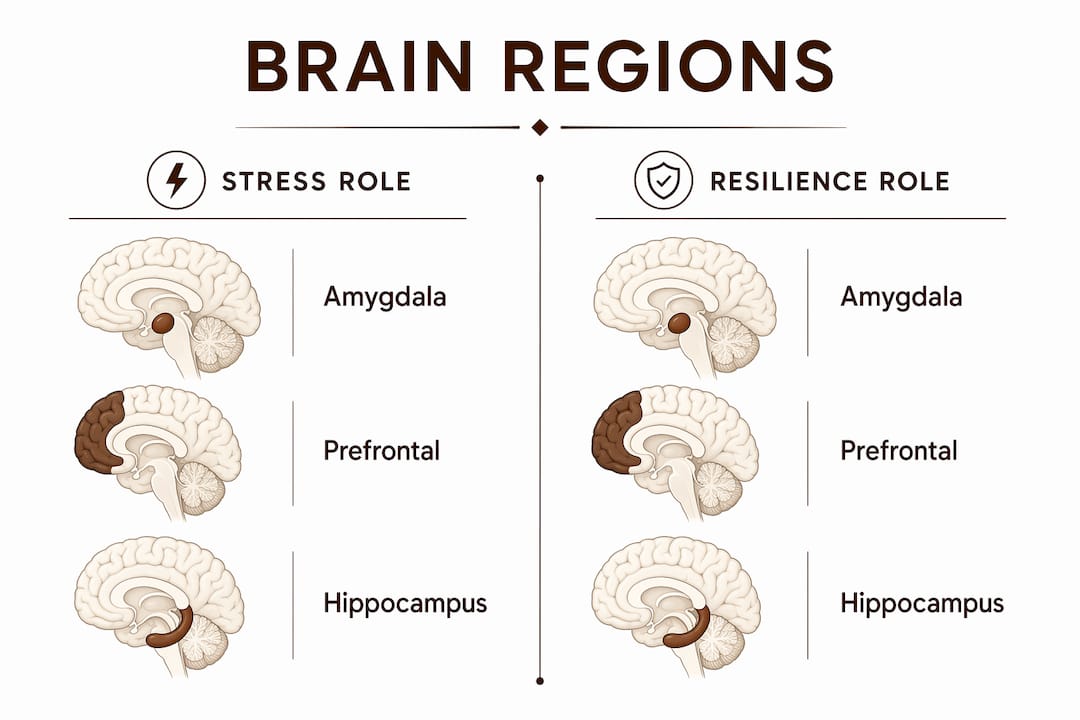
Neuroplasticity makes this rewiring possible. Meaningful change in resilience patterns takes roughly 8–12 weeks of consistent practice. That timeline is not discouraging. It is clarifying. You are not failing if you do not feel different after one week. You are building.
How can you build emotional resilience effectively?
The most effective methods for building emotional resilience are grounded in neuroscience, not willpower. Pushing through stress without processing it is reactive and depleting. Using an intentional internal framework is what makes resilience sustainable.
The five most evidence-based techniques are:
- Cognitive reappraisal. Reframe the meaning of a stressful event. Ask: “What else could this mean?” or “What would I tell a friend in this situation?” Reframing stressful events engages the prefrontal cortex and reduces the emotional impact of the experience.
- Mindfulness practice. Spend 10 minutes daily observing your thoughts without reacting to them. This trains the brain to create space between stimulus and response.
- Emotional labeling. Name your emotional state with precision, multiple times a day. This directly reduces amygdala reactivity and builds self-awareness.
- Stress inoculation. Deliberately expose yourself to manageable discomfort. Cold showers, hard conversations, physical training. Each small stressor you navigate builds tolerance for larger ones.
- Social support. Strong social networks improve resilience outcomes and speed recovery from adversity. Connection is not a luxury. It is a biological buffer against stress.
One common misconception about how to build emotional resilience is that it means toughening up. That framing is wrong. Suppressing emotion does not build resilience. It delays the cost. Validating what you feel before reframing it is the correct sequence. Acknowledgment comes first. Reframing comes second.
Pro Tip: Consistency beats intensity. Ten minutes of daily mindfulness practice for 60 days outperforms a weekend retreat followed by nothing. Build the habit small and protect it.
What are the benefits of emotional resilience for mental health?
The benefits of emotional resilience extend well beyond bouncing back from a bad day. Resilience changes how you process all experience, not just the hard parts.
Key benefits include:
- Faster recovery from episodes of depression and anxiety
- Reduced risk of burnout in high-pressure environments
- Better decision-making under pressure because the prefrontal cortex stays active
- Stronger relationships built on honest communication rather than avoidance
- Greater self-compassion, which reduces the internal cost of failure
Emotional resilience is distinct from coping and stress management. Coping is reactive. It manages the damage after stress hits. Stress management reduces exposure to stressors. Resilience is proactive. It changes how your nervous system processes difficulty at the source.
The long-term picture is significant. People who build resilience consistently report a stronger sense of identity, clearer personal limits, and a reduced need for external validation. That last point connects directly to what Mrhappinessofficial stands for: your worth is not assigned by circumstances. It is built from the inside.
What are the main models used to understand emotional resilience?
Frameworks give structure to a concept that can otherwise feel abstract. Two models stand out for practical use.
Seligman’s 3 P’s Model explains how people interpret negative events. Personalizing, pervasiveness, and permanence of setbacks are the three thinking patterns that erode resilience. When you believe a failure is your fault alone (personalization), affects every area of your life (pervasiveness), and will never change (permanence), recovery becomes much harder. Resilience grows when you challenge all three assumptions.
The 5 Pillars of Emotional Resilience offer a practical structure for development:
| Pillar | What It Means |
|---|---|
| Self-awareness | Recognizing your emotional states in real time |
| Emotional regulation | Managing reactions without suppressing feelings |
| Optimism | Believing outcomes can improve with effort |
| Social connection | Maintaining relationships that provide honest support |
| Purpose | Having a clear reason that motivates recovery |
Both models point to the same truth: resilience is not one thing. It is a set of practiced responses that compound over time. Using a framework does not make the work easier. It makes the work clearer.
Key Takeaways
Emotional resilience is a trainable skill rooted in neuroscience, built through consistent practice, and proven to improve mental health, relationships, and personal identity over time.
| Point | Details |
|---|---|
| Resilience is a skill, not a trait | Anyone can build it through consistent, intentional practice over 8–12 weeks. |
| The brain drives the process | Keeping the prefrontal cortex active during stress is the core mechanism of resilience. |
| Emotional labeling is foundational | Naming feelings precisely reduces amygdala reactivity and builds self-awareness. |
| Acknowledgment before reframing | Validating emotions first prevents toxic positivity and supports genuine recovery. |
| Social support is not optional | Strong relationships are a biological buffer that directly improves resilience outcomes. |
Why resilience building feels harder before it gets easier
Kofi here. The part no article prepares you for is this: the early weeks of building resilience often feel worse, not better. You start paying attention to your emotions, and suddenly there are more of them. That is not failure. That is awareness switching on.
Feeling more intensely during early resilience building is normal. Acknowledgment has to precede effective reframing. You cannot skip straight to “this is a growth opportunity” without first sitting with “this genuinely hurts.” Premature reframing is just toxic positivity with better vocabulary.
What I have found is that the people who build real resilience are not the ones who push hardest. They are the ones who stay honest with themselves longest. They do not perform strength. They practice it quietly, repeatedly, and without needing an audience.
The other thing worth saying: resilience is not about becoming someone who does not feel things. The goal is not numbness. The goal is range. You want to feel the full weight of a hard moment and still be able to choose your next move. That is what emotional control actually looks like. Not a wall. A wide, stable floor.
— Kofi
Wear the reminder every day
Mrhappinessofficial was built around one idea: your identity is not something the world gives you. You carry it.

The Signature Zip Hoodie is not just premium streetwear. It is a daily physical cue. The same way emotional labeling trains your brain to pause before reacting, what you wear can anchor the mindset you are building. Mrhappinessofficial pieces are designed for people who protect their mental space and live without apology. If you are doing the work of building resilience, the full collection reflects exactly that energy. Simple. Clean. Remembered.
FAQ
What is emotional resilience in simple terms?
Emotional resilience is the ability to recover from stress and adversity without losing emotional balance. It is a trainable skill, not a fixed personality trait.
How long does it take to build emotional resilience?
Meaningful resilience development typically takes 8–12 weeks of consistent practice. Small daily habits, like emotional labeling and mindfulness, drive the most lasting change.
What makes someone emotionally resilient?
Emotionally resilient people maintain prefrontal cortex function during stress, name their emotions precisely, use social support, and reframe setbacks without suppressing their feelings.
Is emotional resilience the same as not feeling emotions?
No. Resilience means feeling emotions fully and still being able to choose a clear response. Suppressing emotion depletes resilience rather than building it.
What are the best emotional resilience techniques to start with?
Cognitive reappraisal, daily emotional labeling, and consistent mindfulness practice are the three most evidence-based starting points for building resilience effectively.