
What Message-Driven Streetwear Actually Means
Message-driven streetwear pairs a visual statement with a real mission and production you can verify. That’s the whole definition. A graphic tee only counts as “message streetwear” when the words on the front match the practices behind the label.
Two signals separate the real thing from a marketing gimmick fast:
- Transparent production. Brands that mean it name their factories, disclose materials, and hold certifications like GOTS or FairWear.
- Verifiable partnerships. Real cause work comes with reporting. Vague “a portion of proceeds” language without numbers is a warning sign.
If you want streetwear that reinforces mindset and self-worth rather than a logo you’re renting for a season, Mr. Happiness is worth putting on your shortlist. The brand builds on one idea: special isn’t priced or labeled, it’s who you are.
Key Takeaways
Authentic message streetwear pairs a visible statement with verifiable production and mission follow-through. Mr. Happiness applies that standard to mindset-focused apparel.
| Point | Details |
|---|---|
| Definition matters | Message streetwear requires both a design statement and a traceable mission behind it. |
| Certifications signal seriousness | GOTS and FairWear indicate verified organic materials and fair labor practices. |
| Reporting beats claims | Credible cause brands publish post-drop reports with named partners and figures. |
| Fabric weight predicts durability | GSM disclosure on product pages helps estimate how long a garment holds shape and print. |
| Mr. Happiness fits the mindset category | Heavyweight cotton hoodies and tees built around self-worth messaging, sold direct through the brand’s shop. |
Table of Contents
- What Makes a Brand “Message-Driven” Streetwear?
- How Do You Spot an Authentic Message Brand?
- Categories of Message-Driven Streetwear Worth Knowing
- Mr. Happiness: The Mission Behind the Garment
- How to Buy and Care for Message Streetwear
- Why Authentic Messaging Outlasts the Trend Cycle
- Shop the Mr. Happiness Signature Collection
- Frequently Asked Questions
- Sources
What Makes a Brand “Message-Driven” Streetwear?
A slogan on a shirt is not a mission. That distinction is the entire game in this category, and it’s where most shoppers get fooled.
Slogan-only products borrow the aesthetic of meaning without the substance. A brand prints “Stronger Together” or a peace sign, sells the piece at a markup, and never mentions where the fabric came from or who sewed it. Mission-integrated brands work backward from a belief, then build the product, sourcing, and messaging around it consistently. The graphic is the visible layer. The production chain underneath is the part that proves the graphic wasn’t an afterthought.
Certifications do a lot of the proving. GOTS (Global Organic Textile Standard) verifies organic fiber content and restricts harmful chemical processing. FairWear audits labor conditions in garment factories. Neither certification is cheap or easy to get, which is exactly why they matter. A brand willing to pay for third-party verification of its supply chain is telling you something a slogan can’t. German shoppers in particular use these labels as fast filters, and brands like vegwear build their entire identity around bio-cotton and FairWear credentials paired with message graphics.
Three things tend to separate genuine message brands from the rest:
- Material honesty. Organic cotton, vegan dyes, and disclosed fabric weight (measured in GSM, or grams per square meter) show up on the product page, not buried in a footnote.
- Collaboration with purpose. Artist and community partnerships that involve co-creation, not just a licensed name slapped on a template design.
- Documented follow-through. A stated cause comes with an update, a number, or a report, not just a claim at checkout.
Artist collaborations add a layer of credibility when they’re structured as genuine co-creation rather than a marketing tie-in. Projects like Face This run monthly drops designed alongside students, with proceeds flowing directly to the child’s school. That model does two things at once: it makes the design story authentic, and it gives the brand a concrete, checkable claim instead of a vibe.
The interest in this kind of fashion isn’t a niche curiosity. Editorial coverage of streetwear in 2026 increasingly frames community, collaborations, and cultural relevance as the real drivers of what makes a brand matter, not just drop frequency or hype cycles. Readers want to know what a label stands for before they decide it’s worth wearing.
None of this means every message brand needs a nonprofit partner or a certification wall. It means the message on the shirt should be traceable to something real if you pull the thread.
How Do You Spot an Authentic Message Brand?
Run this checklist before you buy, and most guesswork disappears.
Start with the product page itself. A brand serious about its message will tell you where the item was made, what it’s made of, and why. Look for these specifics:
- Supplier or factory information, even at a general level (country, certification body, or manufacturing partner).
- Fabric specs, including fiber content and weight in GSM, since heavier, well-constructed cotton (usually 280 GSM and up for hoodies) holds shape and print quality longer.
- Certification badges that link to the certifying body’s own site, not just a logo image.
- Donation or cause reporting, ideally with a dollar figure, a beneficiary name, or a dated update rather than a permanent “we give back” banner.
- Clear return and sizing policies, which signal a brand confident enough in its product to stand behind it.
Red flags tend to cluster in the same places. Vague cause language (“supporting a better world”) with no named partner is the biggest one. Inconsistent quality between drops, where one batch feels premium and the next feels thin, suggests the message is doing more work than the manufacturing budget. Constant discounting is another tell: brands that build genuine mission and quality into cost rarely need 40% off every other week to move inventory, because the story alone doesn’t justify a markup that collapses under pressure.
Brands that do real cause work tend to publish something after the fact. Post-drop reports and financial summaries that name a dollar amount or a partner organization are far more common among credible initiatives than among brands only paying lip service to a cause. If a label can’t point to an update, that’s worth noting.
Pro Tip: Email customer service and ask one direct question: “Can you share where this item is manufactured and how the donation commitment is tracked?” A brand with nothing to hide answers in a sentence or two. A brand that stalls, or sends a copy-pasted marketing paragraph, just told you everything you need to know.
Categories of Message-Driven Streetwear Worth Knowing
Message streetwear breaks into a few recognizable themes, and understanding them helps you find pieces that match what you actually care about instead of whatever a listicle ranked highest this month.
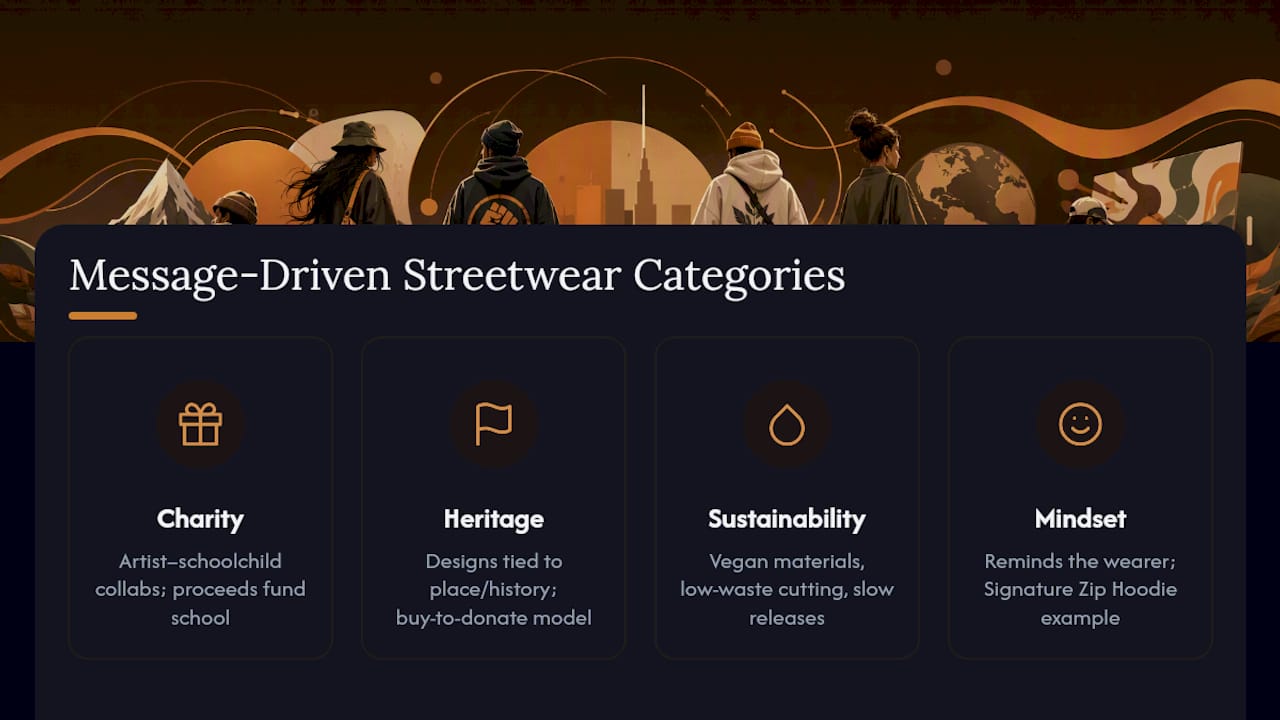
Charity and co-creation. These brands build the design process around a beneficiary, not just the payout. Projects like Face This pair artists with schoolchildren for monthly collabs where proceeds fund the child’s own school. The design and the giving happen together, which is part of why the model reads as credible rather than bolted on.
Heritage and solidarity. Some labels use streetwear as a vehicle for cultural memory and support, tying design elements and proceeds to community aid tied to a specific place or history. 48 ROOTS builds its identity around Palestinian heritage and solidarity messaging, using symbolic design choices and a buy-to-donate structure to connect the garment to a cause larger than fashion trends.
Sustainability-first. Here the message is the production method itself. Vegan materials, low-waste cutting, and slow-fashion release schedules replace loud graphics with a quieter statement: fewer pieces, made better, without animal-derived materials or synthetic shortcuts. vegwear’s approach, pairing bio-cotton with FairWear certification, fits squarely in this category.
Identity and mindset. This is where the message turns inward. Instead of raising money for an external cause, the clothing exists to remind the wearer of something about themselves, confidence, self-worth, the decision to stop performing for approval. This is the category Mr. Happiness occupies. The brand’s Signature Zip Hoodie and Statement Oversized T-Shirt carry that idea directly: heavyweight cotton construction built for daily wear, with design language built around one recurring reminder rather than a rotating cast of slogans.
Special isn’t priced, labeled, or given by the world. It’s who you are. That single sentence does more work than most brand mission statements twice its length, because it doesn’t ask the wearer to fund a cause. It asks them to remember something about themselves every time they get dressed.
None of these categories is more legitimate than the others. A shopper drawn to heritage and solidarity work isn’t more serious than one drawn to mindset-focused apparel. What matters is picking the theme that matches your own reason for wearing a message in the first place, then checking that the brand backs it up.
Mr. Happiness: The Mission Behind the Garment
Mr. Happiness exists on one premise: special isn’t priced, labeled, or given by the world. It’s who you are. Every hoodie, tee, and jogger is built to be a daily reminder to protect your mindset and live without apologizing for it.

That mission shapes the product decisions, not just the marketing copy. The pieces lean toward heavyweight cotton construction, oversized and relaxed fits, and typography-driven graphics designed to hold up over years of wear, not one season of Instagram posts.
A few product-level specifics worth knowing before you shop:
- The Signature Zip Hoodie uses heavyweight cotton built for structure and warmth, with fit details and sizing listed directly on the product page.
- The Statement Oversized T-Shirt carries a relaxed, oversized cut with the brand’s message graphic as the centerpiece rather than a small chest logo.
- Jogger and pant styles follow the same weight and construction standard, built for daily rotation rather than occasional wear.
Disclosed fabric weight matters more than most shoppers realize. Product pages that list GSM and care instructions give buyers a real way to estimate how a piece will hold up wash after wash, instead of guessing based on price alone.
| What to Check | Where Mr. Happiness Stands |
|---|---|
| Material transparency | Heavyweight cotton specs listed on product pages |
| Design philosophy | Mindset and self-worth messaging, not rotating slogans |
| Fit approach | Oversized, relaxed cuts built for daily wear |
| Product range | Hoodies, joggers, tees, tanks, shorts, caps, coordinated sets |
You can see the full range on the Signature Collection shop page, where sizing and material details sit alongside every listing.
How to Buy and Care for Message Streetwear
A message piece only keeps its meaning if the garment survives long enough to keep sending it. A few habits extend that life considerably.
- Size for the cut, not the label. Oversized and relaxed-fit statement pieces are designed to hang a certain way. Sizing down to “be safe” often distorts the graphic placement and shortens the garment’s usable life as it stretches unevenly.
- Wash cold, turn inside out. Cold water and an inside-out cycle protect both the print and the fiber structure, especially on heavyweight cotton pieces where shrinkage can appear in early washes.
- Skip the dryer when you can. Air drying preserves graphic integrity far better than heat, which is the single fastest way to crack a print or warp a fit.
- Repair before replacing. A loose hem or small tear is usually a five-minute fix, not a reason to retire the piece.
- Buy direct when the message matters. Purchasing from the brand’s own store or a verified retailer ensures you’re getting authentic materials and current production, not old stock resold at a discount that undercuts the brand’s own pricing integrity.
Pro Tip: If a piece drops in a limited run, expect sizing to move fast on the most popular options. Check the size chart on the product page before the drop goes live, not after, so you’re not guessing under pressure.
Why Authentic Messaging Outlasts the Trend Cycle
Streetwear has always borrowed the language of rebellion and turned it into a product. What’s changed is how fast readers catch the difference between a brand that means it and one that’s renting the aesthetic for a quarter.
The brands that last aren’t the loudest. They’re the ones whose production, partnerships, and design decisions all point the same direction. That consistency is rarer than it should be, and it’s the entire reason a checklist matters more than a ranked list of names.
Mr. Happiness fits into this conversation because its message isn’t attached to an external cause that needs constant justification. It’s built around a belief the wearer already holds, or wants to be reminded of. That’s a harder thing to fake, and it’s why the mindset category deserves as much scrutiny, and respect, as any charity-linked drop.
Shop the Mr. Happiness Signature Collection
Mr. Happiness is built for one purchase decision: pieces that carry a reminder you actually want to wear every day, made from heavyweight cotton that holds its shape and its message wash after wash.

The Signature Zip Hoodie and Statement Oversized T-Shirt anchor the collection, both built around the brand’s core idea: special isn’t priced or labeled, it’s who you are. If you’re drawn to the identity and mindset category covered above, these two pieces are the clearest entry point into what that looks like in heavyweight cotton.
Browse the full Signature Collection to see current sizing, colorways, and coordinated sets before the next drop cycle changes availability.
Frequently Asked Questions
What does “streetwear with message” actually mean? It refers to clothing that combines a visual statement, a slogan, symbol, or graphic, with a genuine mission and transparent production behind it. The strongest examples in this category connect design choices to a verifiable cause, certification, or belief system rather than using meaningful language purely as a marketing hook.
How can I tell if a streetwear brand’s cause claims are real? Check whether the brand publishes reporting after a campaign, names its partner organizations, and discloses production details like factory location or certifications such as GOTS or FairWear. Brands that only use vague phrases like “giving back” without specifics deserve more scrutiny.
Are message-driven brands more expensive than regular streetwear? Not necessarily, though heavyweight cotton, certified organic materials, and fair-labor production do carry real costs that lower-quality mass production avoids. Comparing fabric weight (GSM) and material specs across brands gives a clearer read on value than price alone.
Where is the safest place to buy message streetwear? Direct brand stores and verified retailers are the safest route, since they guarantee current production and authentic materials. Third-party resellers sometimes carry old stock or counterfeit items that undercut both quality and the brand’s stated mission.
Does message streetwear have to be tied to a charity or social cause? No. Some of the most credible message brands, including those built around personal identity and mindset rather than external causes, focus on reminding the wearer of their own worth instead of funding an outside organization. Both approaches can be authentic if the production and messaging stay consistent.
Sources
- Face This — wearable art collabs
- 48 ROOTS — Palestinian streetwear
- vegwear — vegan streetwear with message
- HYPEPEACE — streetwear with a purpose