
Self-Expression and Wellbeing: Wear Who You Are
Authentic self-expression reliably supports wellbeing, and clothing is one of the most practical, low-risk ways to practice it daily. A longitudinal study published in Nature found that prompting people to post authentically on social media led to higher positive mood and lower negative mood across personality types. The Authentic and Inauthentic Expression Scale (AIES) research confirms that authentic expression is empirically distinct from its inauthentic counterpart and predicts greater satisfaction of three core psychological needs: autonomy, competence, and relatedness. Mrhappinessofficial builds every piece around that premise. Start simple. One anchor piece you actually feel aligned with, like the Signature Zip Hoodie, is enough to begin.
- Authentic expression predicts positive mood and psychological need satisfaction
- Clothing externalizes identity and offers repeated, low-stakes practice
- Mrhappinessofficial designs pieces as identity anchors, not trend items
Table of Contents
- Does self-expression really improve wellbeing?
- How authentic self-expression actually changes your psychology
- Why clothing is one of the best tools for self-expression
- How to use streetwear to express identity and build confidence
- Common pitfalls when using fashion to express identity
- When do wellbeing changes show up, and what does it cost?
- Other ways to build authentic self-expression beyond clothing
- Should you invest in premium streetwear for your wellbeing?
- Key Takeaways
- Why identity-driven apparel matters
- Mrhappinessofficial: premium pieces built for who you are
- Useful sources
Does self-expression really improve wellbeing?
The evidence is consistent. The Nature longitudinal study showed that authentic posting produced measurably higher positive affect and lower negative affect compared to controls. The AIES research adds precision: authentic expression predicts autonomy, competence, and relatedness satisfaction, while inauthentic expression predicts lower autonomy and higher negative affect. These are not the same construct running in opposite directions. They are distinct processes with distinct outcomes.
Statistic: Participants prompted to post authentically showed higher positive mood and lower negative mood across all measured personality types compared to control participants — a finding replicated across the longitudinal design of the Nature study.
One important caveat: a 2026 Springer article found that cultural context moderates these benefits. In collectivist settings, wellbeing often flows through relational pathways rather than independent self-expression. The mechanisms are real; how they operate depends on who you are and where you live.
How authentic self-expression actually changes your psychology
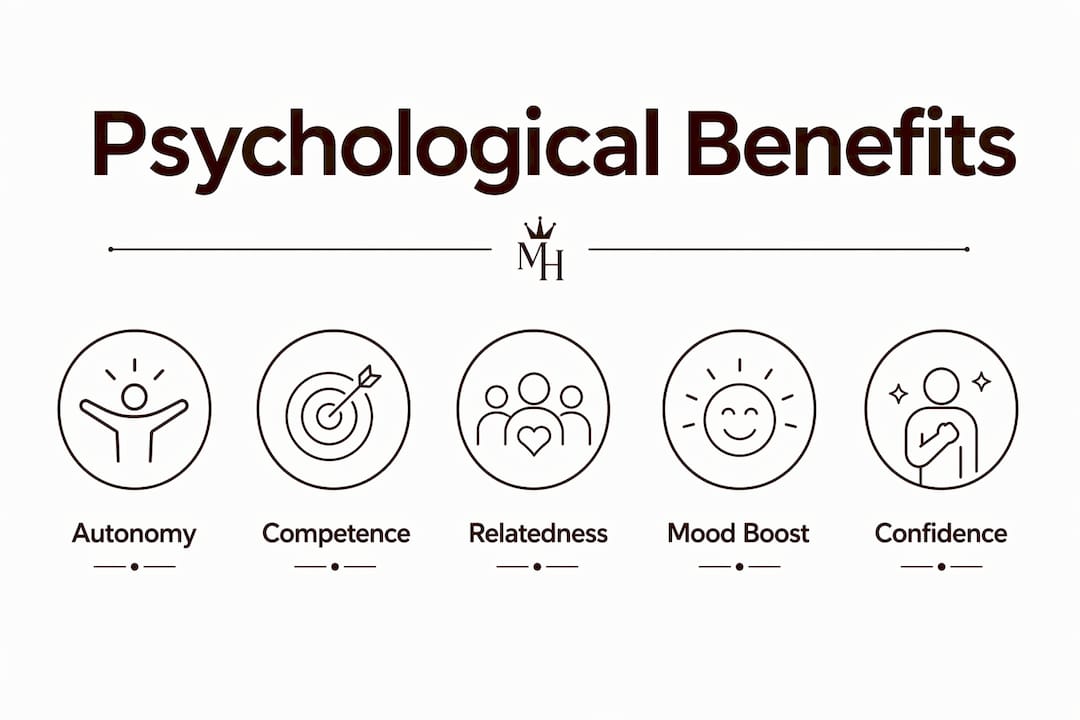
Three psychological needs sit at the center of this. Autonomy, the sense that your actions are genuinely self-directed. Competence, the feeling of mastery and growth. Relatedness, real connection with others. Authentic expression satisfies all three simultaneously, which is why its effects on wellbeing are so consistent across studies.
“When we open up and express ourselves, we move from a state of protection — coddling our ego and manning our inner walls — to a state of partnering: being open to sharing yourself with others and vice versa. This is where we get our best and most innovative work done.” — Judith Glaser
That shift from protection to partnering matters practically. Suppressing authentic expression keeps people in a defensive posture, which raises anxiety and cognitive load. Expressing authentically lowers that guard and makes genuine connection possible. Chronic people-pleasing and boundary erosion are the predictable results of blocked expression, not personality flaws.
Cultural context shapes which mechanism dominates. In individualist settings, autonomous self-expression tends to drive wellbeing directly. In collectivist contexts, relational expression, sharing identity through community rather than broadcasting it independently, tends to carry more weight. Neither is wrong. Both are authentic.
Why clothing is one of the best tools for self-expression
Clothing externalizes identity and offers repeated, low-risk practice of authentic expression every single day. That repetition matters. Each time you choose a piece that reflects who you are, you reinforce the neural and behavioral patterns that make authentic expression easier over time.
The mechanisms specific to apparel are worth naming clearly:
- Material and comfort: A heavyweight, well-constructed piece delivers hedonic benefit. It feels good to wear, which creates a positive feedback loop between the garment and the identity it represents.
- Fit and silhouette: Oversized cuts, tailored drops, and intentional proportions signal identity before a word is spoken. Fit is a form of communication.
- Messaging and graphics: Text-forward design communicates values directly. Pieces like the “Be Unforgettable” Hoodie carry a statement that functions as a daily reminder, not decoration.
- Wearing rituals: Choosing a specific piece for a specific kind of day builds a ritual that reinforces identity over time.
Research on self-expressive consumption identifies two distinct benefit classes: utilitarian (identity maintenance) and hedonic (pleasure from expression). Premium pieces serve both. A fast-fashion item might deliver a surface-level hedonic hit, but it rarely sustains identity maintenance because it was never chosen for that reason.
Pro Tip: Pick one “identity anchor” piece rather than ten trend items. A single premium piece you wear repeatedly builds a stronger, more stable sense of self than a rotating wardrobe of things you bought because they were popular.
Mrhappinessofficial’s core pieces illustrate this well. The Happiness Set (hoodie and joggers together) functions as a cohesive anchor outfit. The Signature Zip Hoodie works as a standalone statement. The Happiness Oversized Tank offers a seasonal alternative that carries the same identity weight in a lighter silhouette.
How to use streetwear to express identity and build confidence
Follow a short sequence: reflect, pick an anchor piece, build rituals, seek community validation, and iterate.
- Reflect on core values. Write down three words that describe who you are at your best. These become your filter for every purchase decision.
- Define the visual cues that express those values. Bold typography? Clean minimalism? Oversized silhouettes? Translate values into aesthetic language.
- Select one premium anchor piece. The Signature Zip Hoodie or The Happiness Set are practical starting points. One piece, chosen deliberately, outperforms ten chosen impulsively.
- Create wearing rituals. Designate certain pieces for certain contexts: a confidence-day outfit, a creative-work uniform, a rest-day set. Rituals reinforce identity through repetition.
- Share authentically in low-risk settings. Wear the piece to a small gathering or post a photo to a trusted group. Small public experiments build competence and relatedness simultaneously.
- Iterate as identity evolves. Authentic self-expression is not static. Revisit your values list every few months and adjust accordingly.
Pro Tip: Budget rule: prioritize one or two premium anchor pieces per season. Balance with versatile basics. Spending more on fewer, better-chosen items produces stronger identity reinforcement than spreading the same budget across many trend pieces.
Common pitfalls when using fashion to express identity
Expression that feels forced or performative undermines wellbeing. The AIES research makes this explicit: inauthentic expression is not just less effective, it actively predicts lower autonomy satisfaction and higher negative affect.
Common pitfalls:
- Trend-chasing over values alignment: Buying what is popular rather than what reflects who you are
- Social comparison spirals: Using social media to measure your identity against others instead of sharing it
- External-validation dependency: Needing approval from others to feel confident in a choice
- Label adoption as identity: Wearing a brand because of its status signal rather than its alignment with your values
- Emotional overspending: Using purchases to manage mood rather than to express identity
Concrete mitigations: run a quick values checklist before buying (does this piece reflect one of my three core values?), run micro-experiments before committing to expensive pieces, and build a small trusted feedback group whose opinion you actually respect.
Pro Tip: Before buying or posting, ask yourself: “Am I choosing this because it reflects who I am, or because I want to be seen a certain way?” The AIES authentic/inauthentic distinction maps directly onto that question.
When do wellbeing changes show up, and what does it cost?
Small mood shifts can appear within days. Stable identity and confidence gains take weeks to months of repeated practice.
- Immediate (days 1–7): Wearing a piece you genuinely feel aligned with produces a near-immediate hedonic lift. Mood improves. Diary studies show authentic expression correlates with daily positive affect from the start.
- Short-term (2–8 weeks): Repeated wearing rituals begin to reinforce identity. Competence and autonomy satisfaction increase as the practice becomes habitual.
- Longer-term (3–6+ months): Stable identity shifts and durable confidence gains emerge. This is where the wellbeing benefits compound.
On cost: one premium anchor piece typically outlasts several fast-fashion alternatives in both durability and psychological return. The identity reinforcement value of a piece you chose deliberately, wear repeatedly, and associate with your best self is not replicable at a lower price point.
Pro Tip: Set a clothing investment plan: one premium anchor piece per season. Test the fit and feel of a category in a lower-cost way before upgrading to a premium version.
Other ways to build authentic self-expression beyond clothing
Combine apparel with creative routines and boundary-setting for bigger, more durable effects. Creative activities satisfy autonomy, competence, and relatedness through the same psychological mechanisms as authentic self-expression, making them natural complements.
- 10-minute values inventory: Write freely about what matters most to you. No editing. This clarifies the values that should drive your apparel choices and everything else.
- Creative hobbies: Music, visual art, design, and writing all satisfy the same three psychological needs that authentic expression does.
- Ritualized self-care: Morning or evening routines that include intentional clothing choices reinforce identity daily.
- Boundary-setting practice: Saying no to requests that conflict with your values is a form of authentic self-expression. It builds autonomy directly.
- Micro-communities: Find small groups, online or in person, that share your values. Relatedness satisfaction rises sharply when identity is validated by people who genuinely understand it.
Sharing your style and identity through platforms you trust can also reinforce authentic expression. Understanding how brand identity functions on social platforms helps clarify how to share without sliding into performative posting.
Should you invest in premium streetwear for your wellbeing?
Yes, when the expression is authentic and paired with reflective practice.
- Start with: A values reflection. Three words. Your filter for every choice.
- Buy: One anchor premium piece that reflects those values. The Signature Zip Hoodie, The Happiness Set, or the Happiness Oversized Tank are practical starting points.
- Avoid: Performative spending. Buying for status or approval rather than identity alignment produces the inauthentic expression pattern the research consistently links to lower wellbeing.
Mrhappinessofficial builds pieces for exactly this purpose: identity anchors, not trend items. The brand’s mission is the reminder that special is who you are, not what you’re labeled.
Key Takeaways
Authentic self-expression supports wellbeing by satisfying autonomy, competence, and relatedness, and clothing is one of the most practical daily tools for that practice.
| Point | Details |
|---|---|
| Authentic expression improves mood | The Nature longitudinal study found authentic posting raised positive mood and lowered negative mood across personality types. |
| Three needs drive the effect | Autonomy, competence, and relatedness are all satisfied by authentic expression, per AIES research. |
| One anchor piece beats many trend items | A single premium piece chosen for values alignment builds stronger identity reinforcement than a rotating trend wardrobe. |
| Wellbeing shifts appear quickly | Diary studies show daily positive affect correlates with authentic expression from the first days of practice. |
| Mrhappinessofficial as anchor | The Signature Zip Hoodie, The Happiness Set, and Happiness Oversized Tank are designed as identity anchors, not status labels. |
Why identity-driven apparel matters
Mrhappinessofficial was built on one conviction: the reminder that who you are is enough. Every piece in the collection, from the Signature Zip Hoodie to The Happiness Set, is designed to function as a daily signal to the person wearing it, not to the room. The brand’s apparel is built around identity, confidence, and self-worth because those are the things that actually move the needle on how people feel day to day. The research backs that up.
Mrhappinessofficial: premium pieces built for who you are
Mrhappinessofficial gives you a direct, no-label route to identity-driven dressing, without chasing trends or paying for someone else’s logo.
Three pieces worth starting with:
- Signature Zip Hoodie: Heavyweight construction, clean silhouette, built to wear on the days that matter most.
- The Happiness Set: Hoodie and joggers as a cohesive anchor outfit. One decision. Complete identity signal.
- Happiness Oversized Tank: A lighter seasonal anchor that carries the same weight in a minimal form.
Pick one piece that reflects your values. Wear it in one small public setting this week. That is the experiment. Browse the full Signature Collection and find the piece that fits who you already are.
Useful sources
- Authentic and Inauthentic Expression Scale (AIES) — ScienceDirect: Development and validation showing authentic expression predicts psychological need satisfaction; inauthentic expression predicts lower autonomy and higher negative affect.
- Nature longitudinal study — authentic posting and mood: Participants prompted to post authentically showed higher positive mood and lower negative mood compared to controls.
- Cultural context moderates self-expression and wellbeing — Springer (2026): Collectivist contexts often realize wellbeing through relational rather than independent self-expression pathways.
- Utilitarian and hedonic benefits of self-expressive consumption — ScienceDirect: Systematic review identifying identity maintenance and pleasure as the two core benefit classes of self-expressive consumption.
- Creative activity and wellbeing — Elsevier: Seven-day experience sampling study showing autonomy, competence, and relatedness mediate the relationship between creative engagement and positive emotion.
- AIES diary-study supplementary material: Diary-study components showing authentic expression correlates with daily positive affect and stable wellbeing outcomes over time.
- Self-expression examples and tips — MasterClass: Practical primer on self-expression exercises including reflective practice and confidence-building habits.
- What is self-expression and why is it important? — Counselling Directory: Clinical summary of how blocked self-expression leads to people-pleasing, loneliness, and mental health harms.