
How Mindset Affects Daily Choices and Confidence
Mindset is defined as the cognitive framework through which you interpret every situation, risk, and opportunity you encounter. How mindset affects daily choices is not abstract philosophy. It is a measurable, neurologically grounded process that determines what you pay attention to, what you avoid, and how confidently you act. Research in decision science and psychological resilience consistently shows that your mental state shapes behavior before you consciously register a choice. The beliefs you hold about yourself and the world function as a filter. Every decision passes through that filter first.
How mindset shapes your decision-making every day
Your mindset directly controls which options you even consider. A growth mindset, the belief that abilities can develop through effort, expands the range of choices you evaluate. A fixed mindset narrows it. This is not motivational language. It reflects how the prefrontal cortex processes value and risk. Positive choice bias correlates with distinct neural patterns in the prefrontal and parietal brain regions, meaning the way you think about outcomes physically changes which neural circuits activate during a decision.

Emotional regulation plays an equally direct role. When stress is high, the brain conserves energy by defaulting to familiar patterns. High cognitive load pushes the brain toward easier, familiar choices to reduce discomfort. That means a stressful morning does not just feel harder. It literally reduces the quality of every choice you make until you recover mental energy.
The gap between a growth and fixed mindset shows up in small, repeated moments. Someone with a growth orientation sees a difficult conversation as information. Someone with a fixed orientation sees it as a threat to their identity. Those two interpretations produce completely different choices, and those choices compound over weeks and months into entirely different life trajectories.
- Growth mindset: Interprets setbacks as feedback, increases risk tolerance, and expands the range of options considered.
- Fixed mindset: Interprets setbacks as evidence of limitation, reduces risk tolerance, and narrows available choices.
- Stress state: Overrides both by defaulting to habitual behavior regardless of mindset orientation.
Pro Tip: Before making any significant decision, take 60 seconds to name your current emotional state out loud. Naming the emotion activates the prefrontal cortex and reduces the amygdala’s grip on your choice.
What mindset blocks are quietly undermining your choices?
The most damaging mindset blocks are not dramatic. They are quiet, repetitive, and disguised as logic. Imposter syndrome tells you that your success is accidental and your next failure is inevitable. Perfectionism reframes inaction as high standards. Comparison bias makes other people’s highlight reel the benchmark for your daily decisions. These patterns do not feel like blocks. They feel like caution.
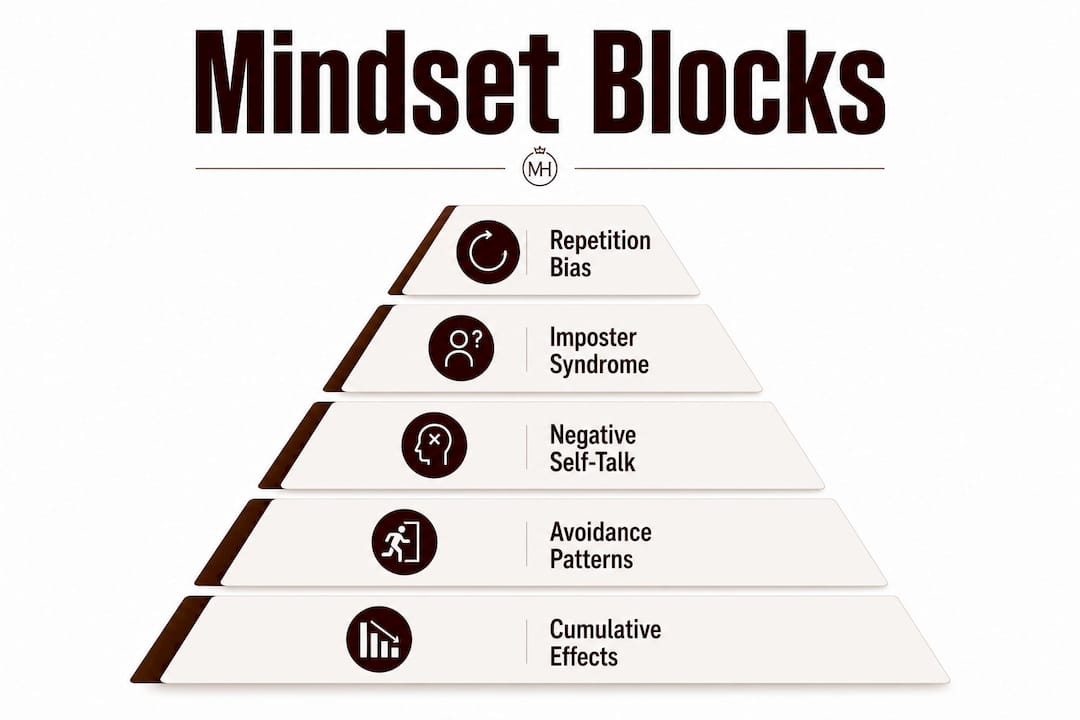
Cognitive biases compound these blocks at the neurological level. Repetition bias builds confidence in habitual choices even without reward, meaning you keep choosing the same options not because they work but because they are familiar. Loss aversion makes potential losses feel roughly twice as significant as equivalent gains, which skews daily decisions toward excessive caution. Delay discounting causes you to favor smaller immediate rewards over larger future ones, which undermines long-term goals like fitness, finances, and relationships.
Here is how these blocks typically stack in a real day:
- Morning comparison: You check social media and immediately measure your progress against someone else’s curated output. Your motivation drops before 9:00 AM.
- Midday perfectionism: A task feels incomplete, so you delay submitting it. The delay creates more cognitive load, not less.
- Afternoon loss aversion: You avoid a conversation that could improve your situation because the risk of discomfort outweighs the potential gain in your mind.
- Evening repetition bias: You default to the same unproductive routine because it requires no new decision-making energy.
Each block feeds the next. By the end of the day, the cumulative effect of these biases has shaped your behavior more than any conscious intention did.
Pro Tip: Identify your single strongest bias by tracking which type of decision you consistently avoid. Avoidance patterns reveal the bias more clearly than any personality test.
What does science say about mindset and decision quality?
The science on this is direct and growing. A study of 862 participants found that a 10-minute mindset intervention promoting an “uncertainty-as-enabling” belief increased exploratory behavior and improved cognitive outcomes under uncertainty immediately after the intervention. Ten minutes. That result shows how quickly a targeted mindset shift can alter decision behavior at a measurable level.
Psychological resilience and decision quality are neurologically linked. A positive choice bias correlates with resilience and specific brain activity patterns in 82 subjects measured by fMRI. Resilient people do not just feel better. They process options differently at the neural level, which produces consistently better choices under pressure.
Agency, the sense that your actions matter and produce real outcomes, physically modifies the neural networks that mediate decisions. Increasing agency boosts the subjective value of positive outcomes and supports healthy risk-taking by activating dopamine pathways. This means that feeling in control is not just psychological comfort. It changes the biological calculus of every choice you make.
“Mindfulness creates a pause between stimulus and response. That pause is where choice lives. Without it, behavior is just reaction dressed up as decision-making.”
Mindfulness builds that pause by increasing present-moment awareness and emotional regulation, which directly reduces the grip of cognitive biases on your choices. The mechanism is not mystical. It is neurological. A regulated nervous system accesses the prefrontal cortex more reliably, and the prefrontal cortex is where deliberate, values-aligned decisions are made.
| Mindset state | Effect on decision-making | Neural mechanism |
|---|---|---|
| Resilient and positive | Broader option evaluation, better outcomes | Prefrontal and parietal activation |
| Agency-oriented | Higher value assigned to positive outcomes | Dopamine pathway activation |
| Uncertainty-enabling | Increased exploration, reduced avoidance | Reduced threat-response interference |
| High cognitive load | Default to familiar, suboptimal choices | Prefrontal cortex disengagement |
Practical strategies to build a mindset that improves daily decisions
The most effective approach to mindset change is identity-based, not willpower-based. Identity-based habit formation reduces internal negotiation by framing daily actions as expressions of who you are rather than tasks you must complete. Instead of “I need to exercise,” the identity-based version is “I am someone who moves every day.” That shift removes the daily decision entirely and replaces it with a behavioral default that aligns with your self-concept.
Micro-practices are the practical engine of this shift. These are small, repeated actions built into existing routines that interrupt unconscious bias at the moment of choice. Micro-practices engage attention at transition points throughout the day, which is exactly when habitual, biased decisions are most likely to occur. A transition point is any moment between activities: waking up, finishing a meeting, starting a meal, or sitting down to work.
- Morning intention: Before checking your phone, state one value you want your choices to reflect today. This primes the prefrontal cortex before external inputs compete for your attention.
- Transition pause: At every major shift in activity, take three slow breaths. This resets cognitive load and reduces the likelihood of defaulting to repetition bias.
- Decision audit: At the end of the day, identify one choice you made from fear and one you made from values. The ratio tells you more than any journal prompt.
- Environment design: Remove the friction from choices that align with your goals and add friction to choices that do not. Your environment shapes defaults more than motivation does.
- Engagement practice: High engagement traits increase the odds of resisting delay discounting by 46%. Build engagement by choosing one daily task to do with full, undivided attention rather than multitasking through it.
Pro Tip: Wear something that reminds you of your identity. Physical cues in your environment, including what you put on your body, anchor your self-concept and reduce the cognitive effort required to make values-aligned choices.
Key Takeaways
Your mindset is the single most consistent variable in the quality of your daily decisions, and it can be deliberately shaped through identity, awareness, and practice.
| Point | Details |
|---|---|
| Mindset filters every choice | Your beliefs about yourself determine which options you consider before you consciously decide. |
| Cognitive biases compound quietly | Repetition bias, loss aversion, and delay discounting stack across the day and erode decision quality. |
| Science backs mindset shifts | A 10-minute intervention improved decision behavior in 862 participants, showing fast, measurable results. |
| Agency changes brain chemistry | Feeling in control activates dopamine pathways and raises the value your brain assigns to positive outcomes. |
| Identity beats willpower | Framing habits as expressions of who you are removes daily negotiation and sustains better choices long-term. |
What I’ve learned about mindset that most articles won’t tell you
Most mindset content focuses on positivity. Think better thoughts, feel better, make better choices. That framing is incomplete, and in my experience, it backfires. Forced positivity without identity work creates a gap between what you tell yourself and what you actually believe. That gap produces more internal conflict, not less.
What actually works is specificity. Not “I want to be more confident” but “I am someone who speaks first in a room.” Not “I want to make better choices” but “I am someone who pauses before reacting.” The more specific the identity statement, the less cognitive effort it takes to act on it. The brain stops negotiating and starts executing.
The other thing most people miss is the role of physical environment and physical cues. What you wear, where you sit, and what you see first in the morning all prime your mental state before a single conscious thought occurs. Mrhappinessofficial was built on exactly this principle. The clothes carry a message. That message becomes a cue. The cue shapes the state. The state shapes the choice. It is not complicated. It is just consistent.
Starting mindset work is not about getting it right immediately. It is about building enough self-awareness to catch yourself in the middle of a biased choice and redirect. That skill takes repetition, not perfection. Give yourself the same patience you would give anyone else learning something real.
— Kofi
What you wear is part of the mindset you carry
Mrhappinessofficial builds premium apparel around one idea: your identity is not assigned by a label or a price tag. It is expressed in how you show up every day.
The Signature Zip Hoodie and the “Be Unforgettable” Hoodie are designed to function as daily physical reminders of the mindset you are building. Heavyweight. Clean. Built to last. Each piece from the Mrhappinessofficial collection carries the same message the research confirms: identity shapes behavior, and what you put on your body is part of the identity you reinforce every morning. Wear the reminder.
FAQ
How does mindset affect daily choices?
Mindset acts as a cognitive filter that determines which options you notice, how you assess risk, and how confidently you act. Research shows that a positive choice bias correlates with distinct prefrontal brain activity, meaning your mental state physically shapes the decisions you make.
Can mindset change quickly or does it take years?
Mindset can shift faster than most people expect. A 10-minute intervention promoting an uncertainty-enabling belief improved exploratory behavior and decision outcomes immediately in a study of 862 participants.
What is the biggest mindset block for daily decisions?
Repetition bias is one of the most pervasive blocks. It builds confidence in familiar choices even when those choices produce no reward, making habitual, suboptimal behavior feel like a reasonable default.
How does mindfulness improve decision-making?
Mindfulness creates a pause between stimulus and response, which reduces the automatic influence of cognitive biases. People with high engagement traits are 46% more likely to resist delay discounting, a bias that favors short-term rewards over long-term goals.
What is identity-based habit formation?
Identity-based habit formation frames daily actions as expressions of who you are rather than tasks you must complete. This approach reduces internal negotiation and supports sustained mindset change by aligning behavior with self-concept rather than relying on willpower.