
Develop Mental Resilience Daily: Your 2026 Habit Guide
What is mental resilience, and how do you build it every day?
Mental resilience is your capacity to absorb stress, adapt to setbacks, and keep moving without falling apart. It’s not a personality trait you either have or don’t. It’s a learned skill built through small, consistent daily habits practiced over time.
Registered psychotherapist Natacha Duke puts it plainly: “When we talk about mental strength, what we’re actually talking about is emotional resiliency, which is the ability to cope with stress and challenges in a healthy way.” That framing matters. Resilience isn’t about being unaffected. It’s about responding well.
The core components researchers point to are control, commitment, challenge, and confidence. Together, they form the foundation of what psychologists call mental toughness. You build them the same way you build physical strength: repetition, consistency, and progressive load.
Key traits and starting habits to develop now:
- Name your feelings daily. Awareness comes before action. You can’t regulate what you haven’t identified.
- Practice self-compassion. Talk to yourself the way you’d talk to a close friend in crisis.
- Set one small, controllable goal each morning. Small targets build proof of competence.
- Journal briefly. Even three sentences before bed creates emotional clarity over time.
- Practice mindfulness. Box breathing or a one-minute meditation interrupts the stress spiral.
- Anchor habits to existing routines. Pairing new practices with what you already do daily makes them stick.
Embedding these practices takes time. Research points to 3–4 months as the realistic window for resilience habits to feel automatic rather than effortful.
How do you develop mental resilience daily through practical habits?
The most effective daily resilience practices are unglamorous. They take minutes, not hours. And they compound quietly across weeks until the nervous system starts defaulting to steadiness instead of reactivity.
Start with these:
- Two-minute reset ritual. When stress spikes, pause. Two minutes of controlled breathing or stillness acts as a circuit breaker for the nervous system.
- Count down and move. Counting backward from five and then physically moving interrupts rumination. Experts recommend this as one of the most immediate tools for breaking hesitation.
- The daily reframe. Each evening, write one sentence: “The thing that frustrated me most today was X.” Then write: “A more accurate reading of X is Y.” This five-minute ritual trains the brain to stop defaulting to catastrophic thinking. Evan Kristine calls it “the cognitive equivalent of brushing teeth.”
- Brief movement. A short walk clears mental static. Mind and body are a team, and movement supports the ability to respond rather than react.
- Journaling. Writing feelings down externalizes them. Duke advises: “Whether that’s through journaling, therapy, or talking to your best friend, the practice of naming your feelings and communicating them effectively is really important.”
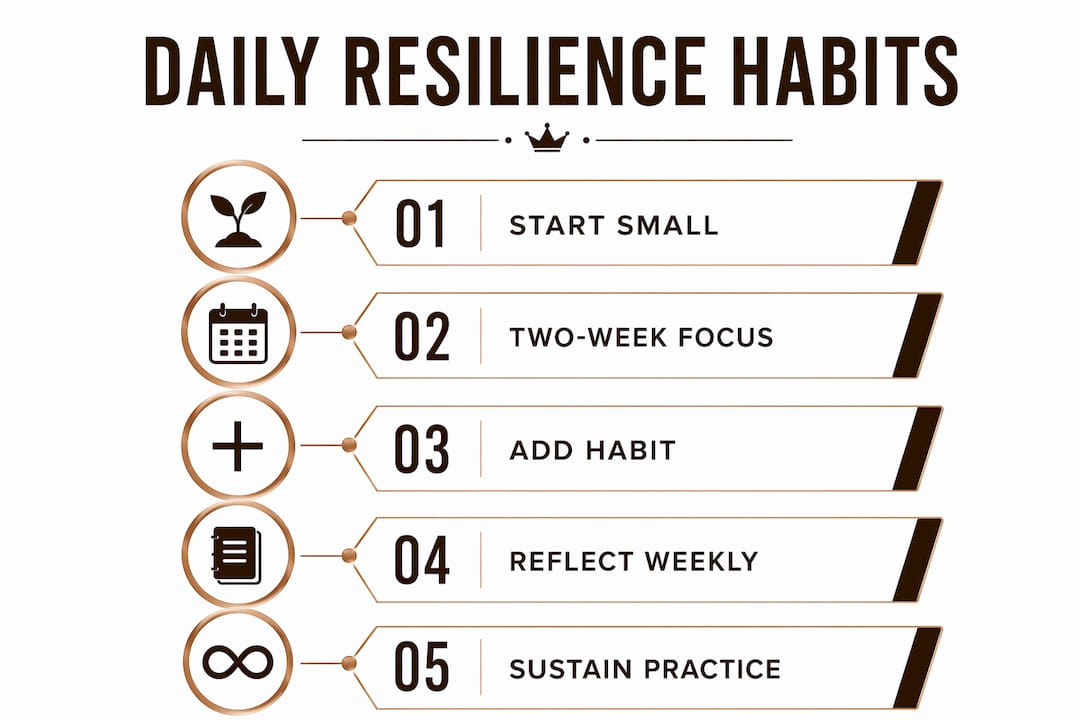
Pro Tip: Don’t install all five habits at once. Pick one, run it for two weeks, then add the next. Stair-stepping prevents burnout and keeps the system sustainable on hard days, not just easy ones.
The faith-centered lifestyle community has long understood this rhythm: small daily rituals, practiced with intention, create the kind of grounded steadiness that holds up under real pressure.
How does mindset shape your ability to build mental strength?
Mindset is the engine underneath every resilience habit. You can follow every technique correctly and still stall if your inner dialogue is working against you.
The most common misconception is that mental strength means suppressing feelings. It doesn’t. Duke is direct on this: managing emotions compassionately, not pushing them down, is what builds sustainable resilience. Suppression creates pressure. Compassionate acknowledgment creates space to problem-solve.
“Practice talking to yourself, not in a critical way, but in the way that you would talk to someone who you really care about and when they are facing a problem. And extend yourself that same love and compassion.” — Natacha Duke, Registered Psychotherapist
Reframing negative self-talk is the practical application of that principle. When the mind says “I can’t handle this,” the resilient response isn’t forced positivity. It’s accuracy: “This is hard, and I can take the next step.” That shift reduces fear of failure and, over time, improves self-esteem in measurable ways.
Duke also highlights the value of distinguishing catastrophes from inconveniences. “We often interpret inconveniences as catastrophes,” she says. “Making that distinction can be helpful. Because if it’s an inconvenience, then you can start to problem-solve.” That one cognitive move, practiced daily, changes how the brain reads difficulty.
How do small wins and habit systems create lasting resilience?
Mental toughness is built through small wins, not grand gestures. James Clear’s research is clear on this: it’s the individual choices made daily, the extra rep, the finished task, the kept commitment, that build the mental muscle. You can’t think your way to grit. You prove it through action.
The habit system that makes this sustainable:
- Anchor new habits to existing ones. Attach your journaling to your morning coffee. Attach your reframe ritual to brushing your teeth at night.
- Stair-step across pillars. Start with one mental habit (daily reframe). Add a physical one (daily walk). Then layer in emotional and social practices across 3–4 months.
- Track small wins explicitly. Keep a “proof list” of hard things you’ve handled. This list becomes evidence against the inner voice that says you can’t cope.
- Treat setbacks as feedback. Missing a day isn’t failure. The resilient move is returning to the habit as quickly as possible, without drama.
- Reward effort, not outcomes. Acknowledge what you did, not just what resulted from it.
The American Psychological Association describes resilience as a process of adapting well in the face of adversity, not the absence of difficulty. That framing redefines what progress looks like. You’re not aiming for a life without hard moments. You’re building the capacity to move through them constructively.
When pressure hits and the habits feel shaky, staying connected to people who reflect your values back to you is one of the most underrated stabilizers. Standing firm during difficult seasons often comes down to community as much as personal practice.
How do you track progress in mental resilience development?
Progress in resilience is rarely linear, and it rarely announces itself. The signs are quieter than people expect.
Watch for these shifts over weeks and months. You react less intensely to the same stressors that used to derail you. Recovery time after setbacks shortens. You notice your feelings earlier and name them more accurately. Journaling entries start to show patterns you couldn’t see before.
Concrete tracking methods that work:
- Weekly reflection. Every Sunday, write down one challenge you faced and how you handled it. Compare entries month to month.
- Mood and stress logs. A simple 1–10 daily rating, tracked in a notebook or app, reveals trends invisible in the day-to-day.
- The proof list. Add one item per week: a hard thing you did, a moment you chose the constructive response. Re-read it when confidence dips.
- Habit streaks. Tracking consistency, not perfection, shows whether the system is holding.
The NHS Every Mind Matters framework recommends taking time each week or month to reflect, recognize, and reward progress. Celebrating small achievements isn’t self-indulgence. It reinforces the neural pathways that make resilience habitual.
What are the best daily exercises to strengthen mental resilience?
These are concrete, time-efficient practices you can slot into any routine:
Morning (5 minutes). Before checking your phone, write one sentence about what you’re carrying into the day. Then name one controllable action you’ll take before noon. This honest check-in stops performance from running ahead of awareness.
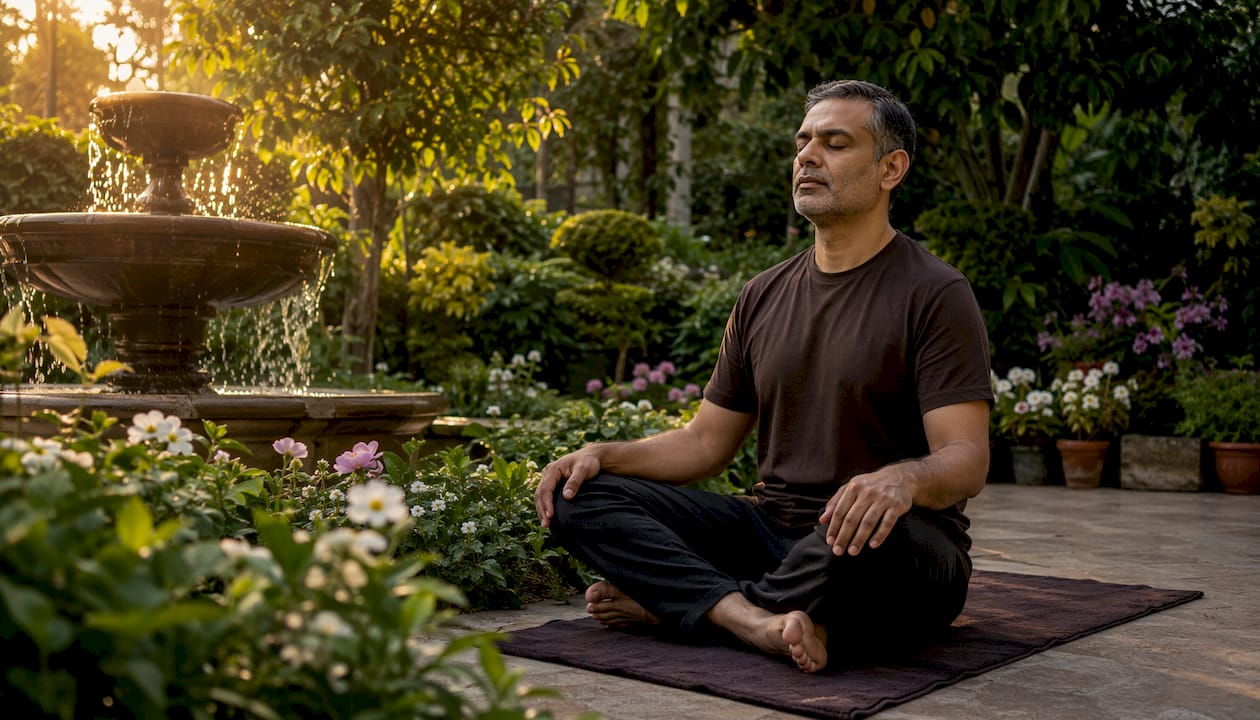
Midday (2 minutes). Box breathing: inhale for four counts, hold for four, exhale for four, hold for four. Repeat four times. This resets the nervous system mid-day without requiring any equipment or privacy.
Afternoon. Notice one extreme thought (“everything is falling apart”) and replace it with an accurate one (“this is hard, and I know my next step”). One swap per day is enough to start shifting the default.
Evening (5 minutes). The daily reframe ritual: name the frustration, write a more accurate reading of it, identify what you actually need to do. Done in a notebook before sleep, this practice compounds quietly across weeks.
Weekly. Connect with one person who helps you stay grounded. Mayo Clinic identifies strong relationships as a core pillar of resilience, not a bonus. Social connection isn’t separate from mental strength. It’s part of the structure.
Physical movement belongs in every day, even briefly. A ten-minute walk after work clears mental static and signals to the body that the pressure doesn’t own the whole day.
Wear the reminder: Mrhappinessofficial and the mindset you’re building
The work of building mental strength is internal. But what you wear can reinforce the identity you’re choosing.
Mrhappinessofficial is a premium streetwear brand built around one idea: who you are doesn’t come from a label. It comes from within. Every piece is designed to remind you to protect your mindset, stay confident, and live without apology.

The “Mindset Over Opinion” Pants and “Mind Over Noise” Joggers aren’t just apparel. They’re daily reminders stitched into the fabric of your routine. The “Be Unforgettable” Hoodie carries the same weight. Premium. Heavyweight. Built to last, like the habits you’re forming.
Mrhappinessofficial speaks to people who are done chasing attention and ready to own their identity. Browse the signature collection and wear what you’re working toward.
Key Takeaways
Developing mental resilience daily is a skill built through consistent small habits, not a trait you’re born with.
| Point | Details |
|---|---|
| Resilience is learned | Daily habits practiced consistently over time embed resilience as an automatic response, not a forced effort. |
| Self-compassion is the foundation | Treating yourself like a trusted friend in crisis reduces stress and builds confidence over time. |
| Small wins build grit | Completing extra tasks or reps regularly proves coping capacity and strengthens the mental toughness muscle. |
| Track progress weekly | A proof list, mood log, and weekly reflection reveal growth that daily experience makes invisible. |
| Mrhappinessofficial | Premium apparel designed to reinforce identity and mindset, worn as a daily reminder of the strength you’re building. |